Published On:
February 5, 2026
Updated On:
February 5, 2026
Union Budget 2026-27 delivers a historic ₹12.2 lakh crore capital expenditure push, focusing on high-speed rail, university townships, and metro expansion to decentralize growth. This infrastructure-first approach is set to unlock new real estate corridors in Tier-2 cities and redefine urban living through enhanced connectivity and dedicated economic zones.
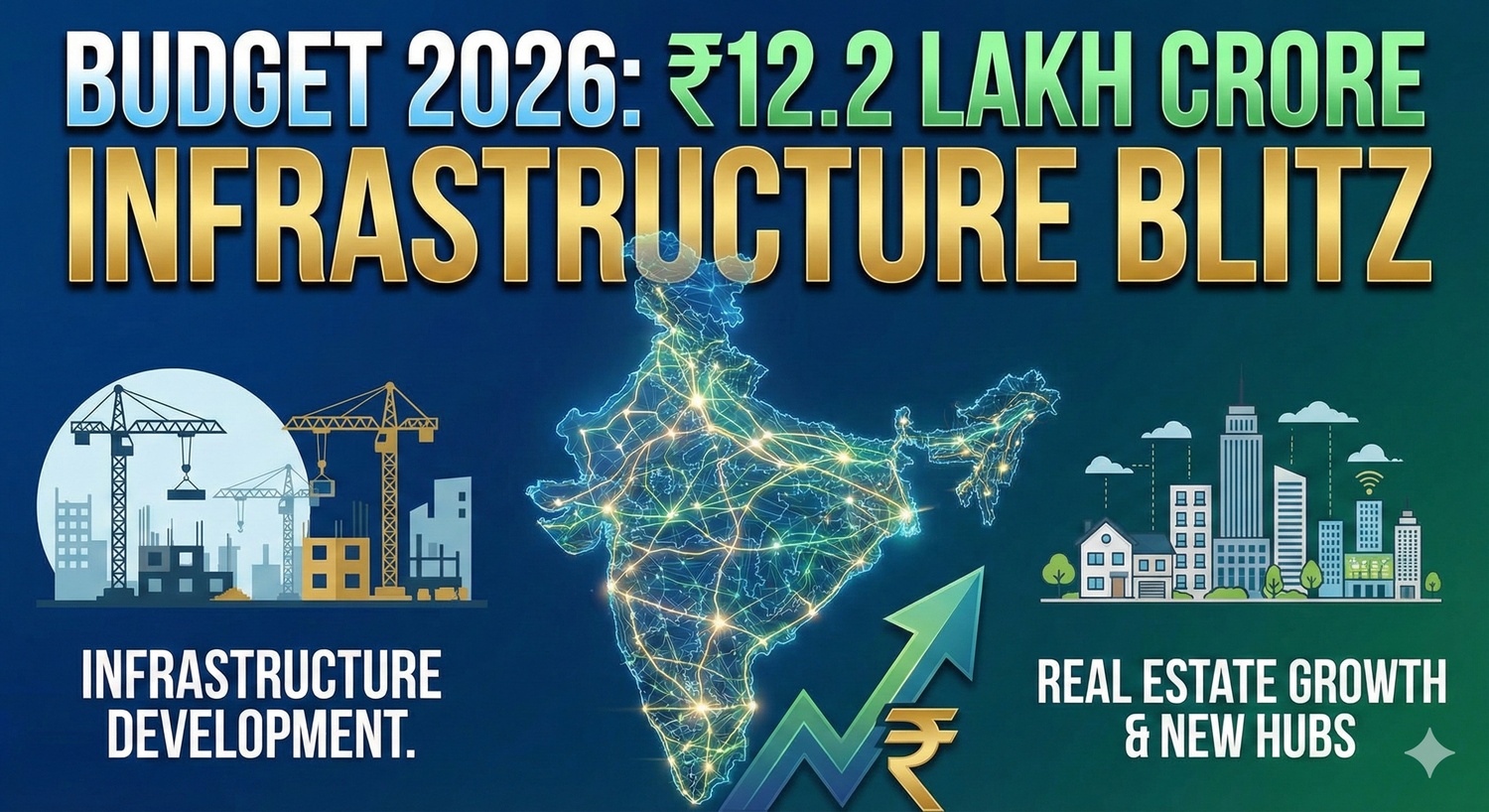
The Union Budget 2026-27 has been tabled, and the message from the Finance Ministry is unmistakable: India is building its way to the future. In what is being hailed as a landmark fiscal roadmap for the real estate and infrastructure sectors, Finance Minister Nirmala Sitharaman has announced a record-breaking Capital Expenditure (Capex) target of ₹12.2 lakh crore. This represents a significant jump from the previous fiscal year, signaling the government's intent to sustain the high-growth momentum through bricks, mortar, and steel.
For the real estate sector, this budget is not just about tax slabs or interest deductions; it is a structural overhaul of the urban landscape. By shifting the focus from mere asset creation to "asset efficiency" and connectivity, the government is effectively expanding the habitable boundaries of our cities. The announcement of new high-speed rail corridors, dedicated university townships, and a renewed thrust on "Housing for All" creates a fertile ground for the next wave of property appreciation.
This blog dissects the fine print of the Budget 2026 announcements and analyzes how this massive liquidity injection into infrastructure will trickle down to your property investments, transform Tier-2 cities, and create entirely new asset classes for the discerning investor.
At the heart of this budget lies the colossal figure of ₹12.2 lakh crore allocated for capital expenditure. To put this in perspective, public capital expenditure has increased manifold over the last decade, becoming the primary engine of India's economic resilience. This 9% increase over the previous year's estimates is designed to create a multiplier effect across the economy.
For the construction and real estate industry, this is a direct steroid shot. A higher capex outlay translates immediately into better roads, faster railways, and modernized logistics. Historically, every rupee spent on infrastructure generates a demand ripple in cement, steel, and labor, eventually boosting consumption power. For homebuyers, this means that the peripheral areas—often ignored due to poor accessibility—will now come into the mainstream. The government’s strategy is clear: build the road, and the city will follow. This massive spending plan is expected to de-risk long-gestation projects and encourage private developers to venture into new geographies, knowing that the state is underwriting the connectivity risks.
Perhaps the most exciting announcement for the daily commuter and the real estate investor alike is the greenlighting of seven new High-Speed Rail corridors. These "Growth Connectors" are designed to slash travel times between major economic hubs, effectively merging distinct property markets into unified economic clusters.
Routes such as Mumbai-Pune, Pune-Hyderabad, and Delhi-Varanasi are set to see a complete transformation. When travel time between two cities drops to under two hours, the concept of a "satellite town" evolves. We are looking at the rise of the "super-commuter"—professionals who live in affordable, spacious homes in smaller cities like Pune or Varanasi while working in financial capitals like Mumbai or Delhi. This will inevitably drive up real estate prices in the terminal cities of these high-speed networks.
Complementing this inter-city connectivity is the aggressive expansion of the Metro network. The budget has outlined plans for "Metro 3.0," which prioritizes not just the expansion of existing networks in metros but the introduction of metro rail systems in Tier-2 cities. The focus on "Metro Neo" and "Metro Lite" technologies ensures that smaller cities get modern transit systems at a fraction of the cost. For a property owner in a city like Kochi, Patna, or Nagpur, the arrival of a metro line is the single biggest driver of capital appreciation, often pushing land rates up by 20-30% within months of operationalization.
One of the most innovative proposals in Budget 2026 is the establishment of five dedicated "University Townships." Moving away from the traditional model of isolated college campuses, these townships are envisioned as integrated hubs located near major industrial and logistics corridors.
This initiative is a game-changer for the rental real estate market. Globally, "Student Housing" is a mature and highly lucrative asset class, but in India, it has largely remained unorganized. By creating planned university cities, the government is generating a concentrated demand for hostels, paying guest (PG) accommodations, and faculty housing.
For investors, these zones represent a golden opportunity. Properties located within or adjacent to these educational townships will enjoy high rental yields and near-zero vacancy rates. Furthermore, the proximity to industrial corridors ensures a steady flow of corporate tenants and research professionals, diversifying the tenant mix. This move also promises to decentralize the student population from saturated education hubs like Kota or Mukherjee Nagar to new, planned urban centers, thereby spreading real estate demand more evenly across the country.
While the industry had high hopes for direct tax sops, the government has chosen a supply-side intervention to tackle the housing shortage. The allocation for the Pradhan Mantri Awas Yojana (PMAY) Urban 2.0 has seen a significant increase, reaffirming the commitment to "Housing for All."
The budget explicitly targets the construction of two crore additional houses over the next five years. This continued push is vital for the affordable housing segment, which has faced headwinds due to rising input costs. By subsidizing the construction and offering interest subvention schemes for the middle class, the government is ensuring that the bottom of the pyramid continues to have access to homeownership.
Crucially, the budget emphasizes "dignified living" for the urban poor and migrant workers. The focus on rental housing complexes near industrial centers is a nod to the changing nature of the workforce. For developers, this opens up a volume-game opportunity in the affordable segment, supported by government grants and faster approvals. The push for digitizing land records further sweetens the deal, promising to reduce the litigation risks that often plague affordable housing projects.
If the previous decade was about the metros, the next decade belongs to Bharat. The Budget 2026 allocates a dedicated corpus of ₹5,000 crore per "City Economic Region" (CER) to develop mid-sized cities into independent growth hubs. This includes a special focus on "Temple Towns" and tourism corridors.
This policy shift recognizes that India’s urbanization cannot be sustained by five or six mega-cities alone. By funding infrastructure in cities with populations over 5 lakh, the government is creating a new tier of real estate markets. Cities like Surat, Visakhapatnam, Lucknow, and Indore are poised to benefit from this decentralized approach.
For the real estate sector, this means the "next big opportunity" is likely not in a saturated suburb of Mumbai or Delhi, but in a developing corridor of a Tier-2 city. The lower entry barriers, combined with the new infrastructure push, offer a higher percentage of capital appreciation compared to the stagnant luxury markets of the metros. The introduction of the Infrastructure Risk Guarantee Fund will further embolden private players to invest in these emerging markets, knowing that a credit safety net is in place.
In a move to monetize immense value locked in public holdings, the Finance Minister proposed the creation of dedicated Real Estate Investment Trusts (REITs) for Central Public Sector Enterprises (CPSEs). Government entities own massive land banks and commercial assets in prime locations across India, many of which are underutilized.
By pooling these assets into REITs, the government aims to monetize land without selling it outright. This will flood the market with high-quality, Grade-A commercial spaces, deepening the Indian REIT market. For the retail investor, this offers a new avenue to earn passive income from government-backed real estate assets. It also sets a benchmark for transparency and professional management of public land, which could eventually influence the broader commercial real estate standards in the country.
The Union Budget 2026-27 may not have offered the immediate gratification of a tax slab overhaul for homebuyers, but it has offered something far more valuable: a vision for sustainable, long-term growth. By committing a record ₹12.2 lakh crore to capital expenditure, the government has ensured that the wheels of the real estate sector will keep turning.
The focus on connectivity—through high-speed rail, metro expansion, and expressways—is the ultimate de-risking mechanism for property investment. It opens up new lands, reduces the pressure on city centers, and improves the quality of life for the average citizen. Whether you are a student looking for a campus in a new university township, a middle-class family eyeing a PMAY home, or an investor scouting for high-growth corridors in Tier-2 cities, this budget has laid the foundation for your next move. The infrastructure is being built; the real estate boom is simply the inevitable next stop.
