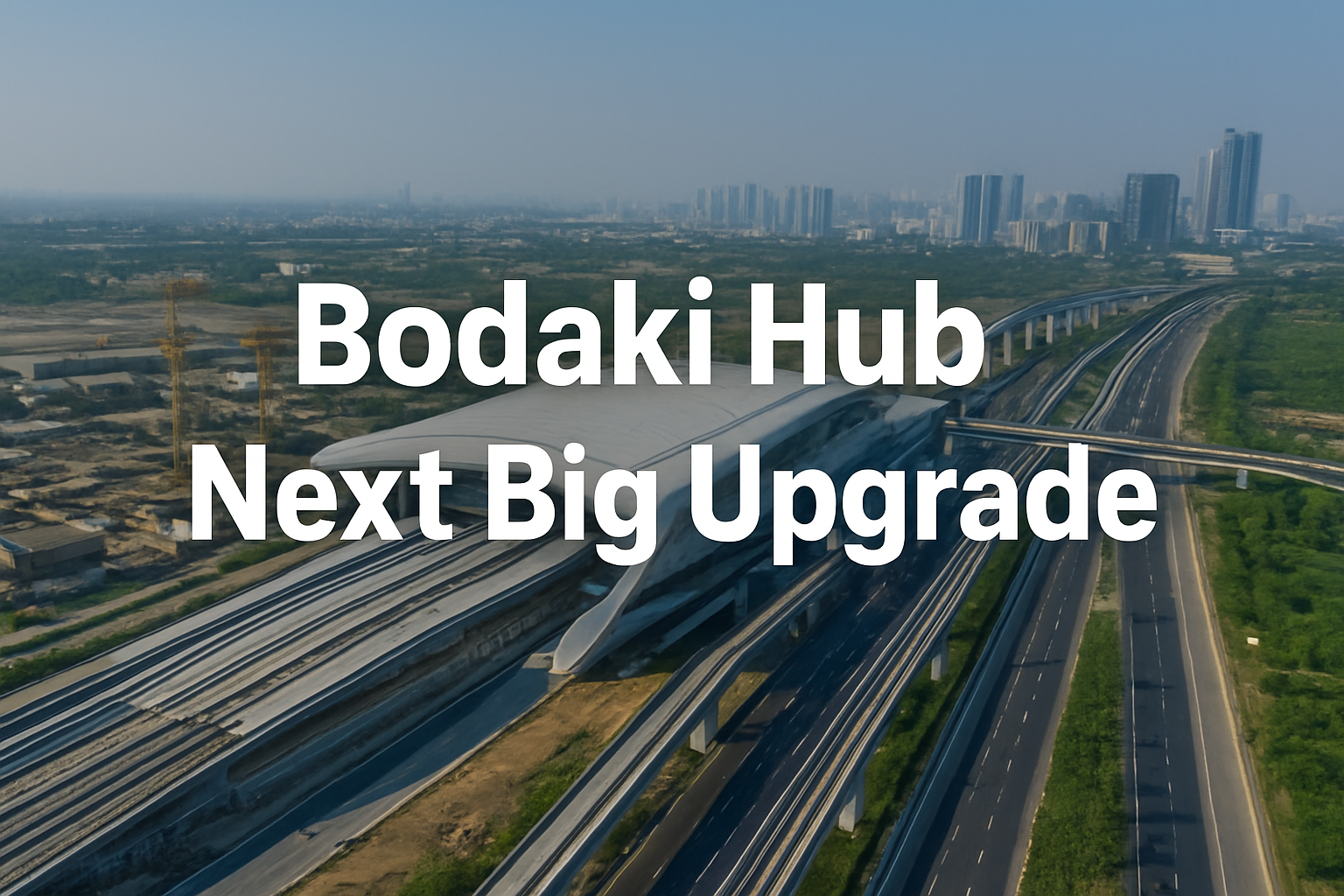
Bodaki, Greater Noida is being reshaped into one of North India’s largest multi-modal hubs — connecting rail, metro, bus, & road systems in one place.
For years, Greater Noida was viewed primarily as a residential alternative to the crowded lanes of Delhi and Noida—a city of wide roads, green roundabouts, and affordable housing. While sectors like Alpha and Beta thrived, the deeper pockets towards Dadri and Bodaki remained largely agricultural, waiting for a catalyst. That catalyst has finally arrived, and it is not just a single project; it is an entire ecosystem.
Bodaki is no longer just a village on the map; it is being forged into the "Central Nervous System" of Northern India’s logistics and passenger mobility. With the government greenlighting the Multi-Modal Transport Hub (MMTH) and the Multi-Modal Logistics Hub (MMLH), this region is set to rival the scale of transport centers in Europe and East Asia.
The vision is audacious: A commuter can step off a high-speed train from Kolkata, take a metro to Jewar Airport, or catch an interstate bus to Rajasthan—all within the same complex. For investors and homebuyers, this shift from "residential suburb" to "economic power center" signals the start of a new golden era for Greater Noida real estate.
The Grand Master Plan: What is Being Built?
To understand the magnitude of the Bodaki project, we must dissect its components. It is not merely a railway station renovation; it is a greenfield development spread across approximately 478 hectares, designed to decongest New Delhi and Anand Vihar terminals.
1. The World-Class Railway Terminal
At the heart of this project is the transformation of the humble Bodaki Railway Station into a world-class terminal.
- Capacity: The new station is being designed to handle 100 trains daily, including flagship Vande Bharat Express and Rajdhani services.
- Connectivity: It will serve as the primary gateway for East-bound traffic. Trains heading to Bihar, West Bengal, and Eastern UP will originate here, saving millions of NCR residents the trouble of crossing the Yamuna to reach New Delhi Railway Station.
- Infrastructure: With 16 platforms and modern passenger amenities, it will feature airport-style concourses, segregated arrival/departure zones, and integrated commercial retail spaces.
2. The Multi-Modal Transport Hub (MMTH)
The MMTH is the "glue" that connects various modes of transport.
- Inter-State Bus Terminal (ISBT): A massive ISBT is under construction to handle 5,000 buses daily. This will be the new nodal point for buses heading to Western UP, Uttarakhand, and Rajasthan, taking the load off Kashmere Gate and Anand Vihar ISBTs.
- Metro Connectivity: The Noida Metro Rail Corporation (NMRC) has approved a critical 2.6 km extension of the Aqua Line. A new spur will connect the existing Greater Noida Depot station directly to the Bodaki MMTH. This means a passenger can travel from Sector 51 Noida to Bodaki seamlessly.
- Rapid Rail (RRTS) Integration: Future alignments of the Delhi-Alwar and Delhi-Meerut RRTS networks are being planned to have interoperability with this hub, ensuring high-speed access to Gurgaon and Delhi.
3. The Multi-Modal Logistics Hub (MMLH)
While the MMTH moves people, the MMLH moves the economy.
- Dedicated Freight Corridor (DFC): Bodaki sits right on the intersection of the Western and Eastern Dedicated Freight Corridors. This is a logistical goldmine. A 3.5 km dedicated railway track is being laid to connect the logistics hub directly to the DFC.
- Industrial Impact: This facility will allow manufacturers in Greater Noida, Yamuna Expressway, and Noida to ship goods directly to ports in Mumbai (JNPT) or Kolkata in under 24 hours, bypassing the slow passenger rail network entirely. This efficiency is expected to attract billions in manufacturing investment.
The Commercial Power Centre: A New CBD
An often-overlooked aspect of the Bodaki master plan is the "Commercial Zone." The government realizes that a transport hub of this scale creates massive footfall, and where there are people, there is commerce.
The master plan earmarks over 65 acres specifically for commercial development within the hub. This is set to become Greater Noida’s new Central Business District (CBD).
- Office Spaces: High-rise office towers are planned to house logistics companies, MNCs, and government offices that need proximity to the transport grid.
- Hospitality: With thousands of transient passengers and business travelers arriving daily, there is an immediate demand for 3-star and 4-star hotels. Several hospitality chains are reportedly in talks to acquire land parcels within the zone.
- Retail & Malls: Unlike the standalone malls of the past, the retail zones here will be "transit-oriented developments" (TOD), integrated into the station complex, similar to the Seawoods Grand Central in Navi Mumbai.
Real Estate Impact: The "Bodaki Effect"
The announcement of these projects has already triggered a speculative boom in the surrounding sectors. Smart investors are moving their focus from the saturated "Noida Extension" to the "Bodaki Circle."
1. The Beneficiary Sectors: Delta, Zeta, and Eta
The sectors closest to Bodaki—Delta 1, Delta 2, Zeta 1, and Eta 2—are the immediate beneficiaries.
- Price Appreciation: Data from late 2025 indicates a sharp 15-20% year-on-year appreciation in land rates in these sectors. A plot in Delta 1, which was trading at ₹60,000-₹70,000 per sq. yard a few years ago, is now commanding a significant premium due to its "future metro-connected" status.
- Rental Yields: With the logistics hub expected to create 50,000 direct jobs, the rental demand in these sectors is shifting. We are seeing a rise in demand for "corporate guest houses" and PG accommodations for the workforce that will build and operate these hubs.
2. New Project Launches
Private developers have smelled the opportunity.
- Sarvottam Megapolis: Located directly in the vicinity, this project has seen renewed interest from investors looking for plotted developments.
- Migsun Nehru Place 1: Situated on the Yamuna Expressway but within the influence zone, this mixed-use project is pitching itself as a support center for the upcoming airport and transport hub.
- Ace Acreville: A newly launched plotted township along the expressway, marketing its connectivity to both Jewar and Bodaki as a dual advantage.
3. The "Warehousing" Gold Rush
For investors with deeper pockets, the real play is industrial land. The villages surrounding Bodaki—Chamrawali, Bodaki, and Chithera—are seeing a rush of land aggregation for private warehousing parks. With the MMLH coming up, every e-commerce giant and 3PL (Third Party Logistics) player wants a warehouse within a 5 km radius of the freight corridor terminal.
Challenges and Timeline: A Reality Check
While the picture is rosy, investors must exercise patience. Mega-infrastructure projects in India have gestation periods.
- Land Acquisition: While 90% of the survey work is done, the final acquisition of the last 10% of land from local farmers has historically been a friction point. The administration is currently running "consent camps" to expedite this.
- Construction Timeline: The metro extension and the first phase of the railway terminal are targeting a 2028-2029 operational timeline. This is a long-term hold, not a quick flip.
Conclusion: The 2030 Vision
By 2030, Bodaki will not be recognizable. It will be a bustling metropolis where the whistle of a freight train harmonizes with the hum of a metro and the bustle of a shopping mall. It represents the shift of Greater Noida’s center of gravity southwards.
For the investor, the strategy is clear: Go South. The northern sectors of Greater Noida are saturated; the southern sectors near Bodaki are where the infrastructure arbitrage exists today. Buying a plot or a retail shop in Delta or Zeta today is akin to buying in Dwarka Sector 21 before the Metro Airport Express line was built—a bet on connectivity that is almost guaranteed to pay off.
The "Power Centre" is shifting, and for once, the train hasn't left the station yet. You still have time to board.