Published On:
February 1, 2026
Updated On:
February 1, 2026
The Greater Agra Master Plan 2041 envisions a massive urban expansion, establishing a "New Agra" near the Yamuna Expressway with a focus on sustainable industrial hubs and logistics. With the development of the Atal Puram township and improved connectivity via the Inner Ring Road, the plan aims to generate over 10 lakh jobs while preserving the city’s heritage.
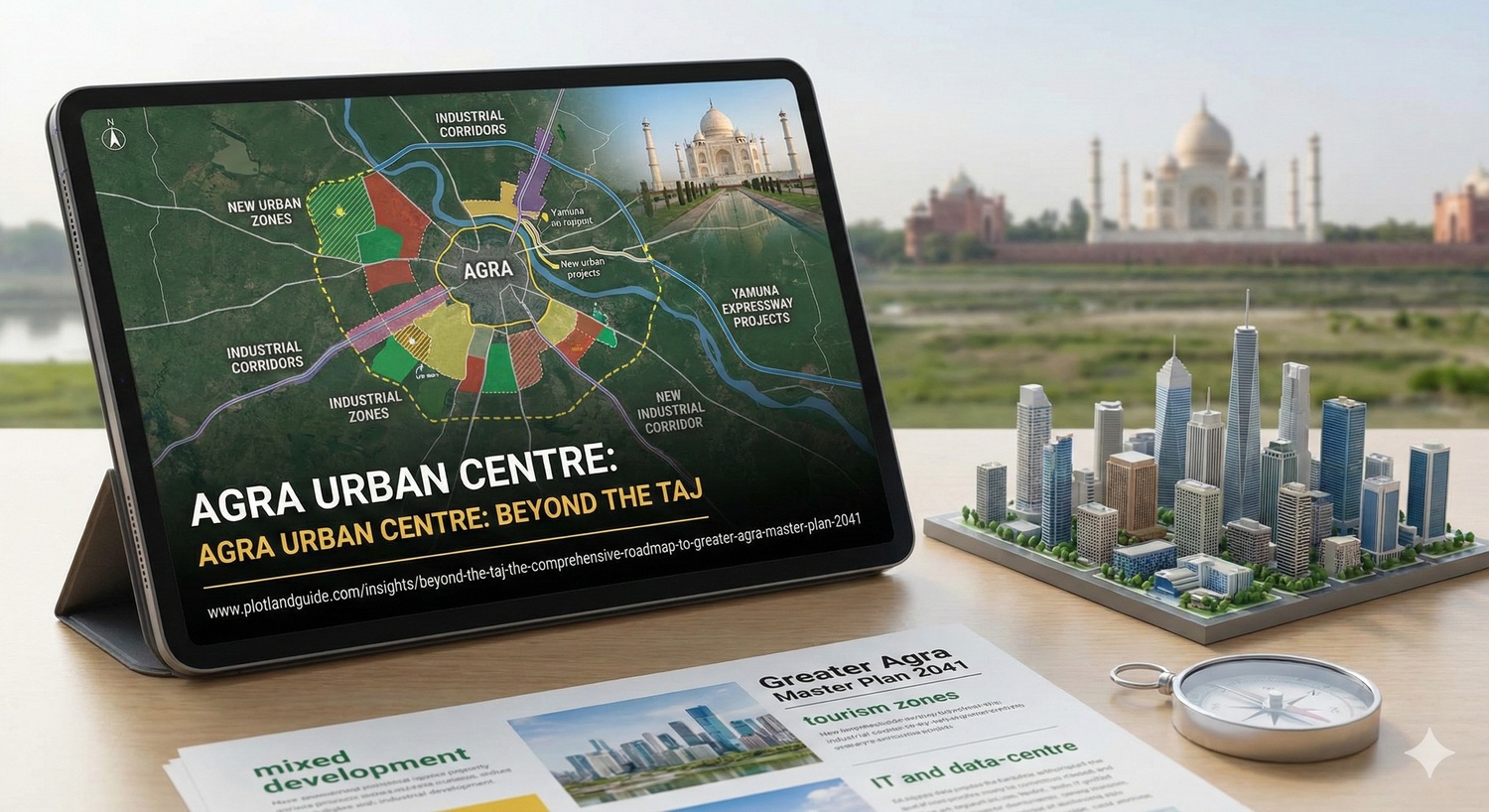
For centuries, Agra has been defined by a single, magnificent silhouette—the Taj Mahal. The world knows it as a city of history, heritage, and romance. But for the people who live there, Agra is a city bursting at the seams. The narrow lanes of the old city, the congestion around heritage sites, and the lack of modern industrial space have long signaled a need for change.
That change has finally arrived in the form of the Greater Agra Master Plan 2041.
This is not just another municipal document; it is a radical reimagining of the city’s geography and economy. Moving the focus away from the dense, protected Taj Trapezium Zone (TTZ), the new plan looks outward, envisioning a "New Agra" that rivals the planned efficiencies of Noida and Gurgaon. With the integration of dozens of new villages, the creation of dedicated logistic hubs, and the launch of futuristic townships, Agra is stepping out of the shadow of its past to build a sustainable future.
This comprehensive guide decodes the Master Plan 2041, exploring where the city is growing, what it means for real estate investors, and how it balances the delicate scales of development and conservation.
The core philosophy of the Master Plan 2041 is decentralization. The existing city is saturated. To save it, development must move elsewhere. The plan effectively creates a dual-city structure:
This "New Agra" is not a vague concept. The Yamuna Expressway Industrial Development Authority (YEIDA) has drafted a blueprint covering approximately 14,480 hectares. This massive land bank is projected to support a population of over 15 lakhs and generate nearly 10 lakh jobs over the next two decades.
The expansion is strategic, targeting specific corridors that offer the best connectivity. The plan identifies key nodes that will serve as the engines of this growth.
The most ambitious part of the plan is the development of the Agra Urban Centre near the Yamuna Expressway. This area is designed to be a self-sustaining ecosystem. Unlike the organic, chaotic growth of old Agra, this zone follows a grid-based, sector-wise planning model similar to Greater Noida.
While YEIDA focuses on the expressway, the Agra Development Authority (ADA) is executing its own flagship project: Atal Puram. Located strategically at the junction of the Inner Ring Road, Southern Bypass, and Gwalior Road, this township is ADA’s largest housing project in decades.
Atal Puram is significant because it represents a shift in how the government acquires land. By purchasing land directly from farmers at mutual consent rates (often four times the circle rate), the authority has bypassed the litigation delays that usually plague such projects. For investors, this township offers a secure, government-backed entry point into the Agra real estate market, with plots available for residential, commercial, and group housing needs.
A master plan is only as good as the roads that connect it. The 2041 vision relies heavily on a robust infrastructure network to link the new growth centers with the old city and the wider region.
The lifeline of this new expansion is the Agra Inner Ring Road. It serves a dual purpose:
The ongoing Agra Metro project is integrated into the 2041 plan, with proposed extensions to link these new townships. Furthermore, the plan capitalizes on the proximity to the upcoming Noida International Airport at Jewar. The "New Agra" zone is essentially the southern anchor of the Yamuna Expressway industrial corridor, placing it just an hour away from what will be India’s largest airport. This proximity is a game-changer for logistics and export-oriented businesses.
For decades, Agra's economy has been a "one-trick pony," relying almost exclusively on tourism and small-scale handicrafts. The Master Plan 2041 aims to diversify this economic base.
Agra occupies a unique geographic position at the crossroads of North India, connected by the Yamuna Expressway, the Agra-Lucknow Expressway, and major national highways. The plan leverages this by proposing a dedicated Transport Nagar and logistics hubs. Warehousing is expected to be a major boom sector here, serving the e-commerce giants that need to distribute goods across Uttar Pradesh and Madhya Pradesh.
While heavy industry is restricted, the plan supports the modernization of Agra’s traditional strengths. A dedicated Leather Park and zones for petha manufacturing and stone handicrafts are proposed. These zones will provide modern infrastructure, common effluent treatment plants (CETPs), and better market linkages, allowing these age-old industries to scale up without polluting the city.
Tourism remains the heart of Agra, but the Master Plan envisions a shift from "monument viewing" to "experience tourism."
Developing in the Taj Trapezium Zone comes with immense responsibility. The Supreme Court and environmental bodies keep a hawk’s eye on Agra’s pollution levels. The Master Plan 2041 addresses this proactively.
For real estate investors, the Greater Agra Master Plan 2041 signals a clear "Buy" signal, but location is key.
Where to Invest?
Despite the optimistic roadmap, execution remains the hurdle.
The Greater Agra Master Plan 2041 is a statement of intent. It acknowledges that Agra cannot continue to live in the past. By building a parallel urban ecosystem, it seeks to preserve the sanctity of the Taj Mahal while fulfilling the aspirations of a modern, growing population.
For the residents of Agra, it promises a cleaner, less congested city. For the youth, it promises jobs in new-age sectors. And for the nation, it promises that one of its most iconic cities will finally have infrastructure worthy of its global fame. The foundation stones have been laid; the next two decades will determine if the City of the Taj can successfully transform into a City of the Future.
