Published On:
February 3, 2026
Updated On:
February 3, 2026
Union Budget 2026-27 signals a decisive shift towards Tier-2 and Tier-3 cities with a ₹12.2 lakh crore infrastructure push and the creation of City Economic Regions. This strategic decentralization is set to ignite a fresh wave of housing demand and logistical efficiency in India's emerging urban centers.
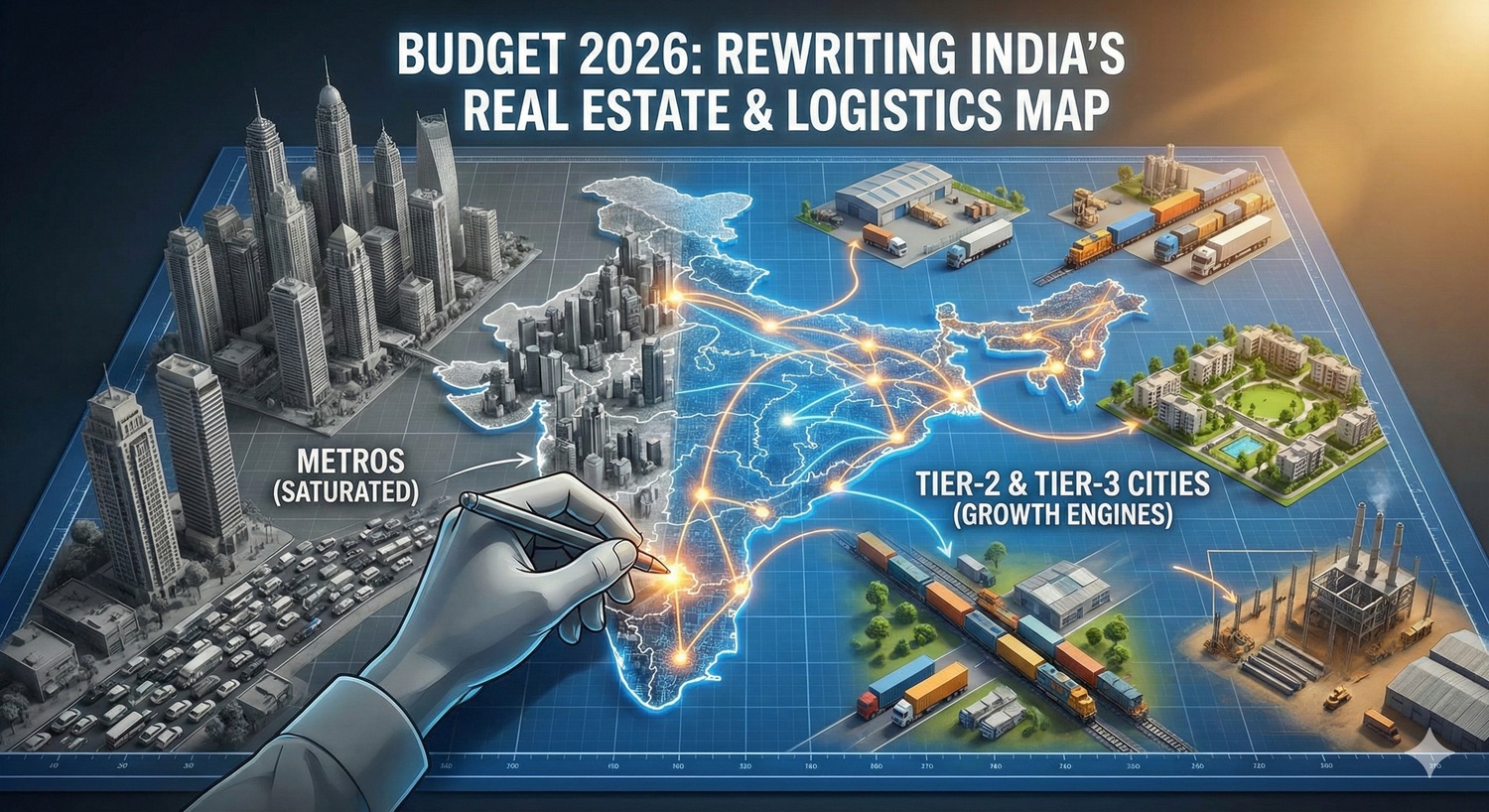
For decades, India’s economic story has been overwhelmingly metro-centric. The skylines of Mumbai, Delhi, and Bengaluru have dominated the narrative of growth, often at the cost of crippling congestion and skyrocketing living costs. However, the Union Budget 2026-27 marks a pivotal departure from this tradition. By channeling a record ₹12.2 lakh crore into capital expenditure, the government has made its intent clear: the next phase of India's growth will not be led by its megacities, but by the aspiring Tier-2 and Tier-3 hubs.
This isn't just about paving roads; it is a structural reimagining of urbanization. With the introduction of concepts like City Economic Regions (CERs) and a renewed focus on multi-modal logistics, the budget lays the groundwork for a more balanced, distributed economic model. For investors, homebuyers, and businesses, the spotlight has firmly shifted to the "next 50" cities that are poised to become the engines of a Viksit Bharat.
One of the most transformative announcements in this year's financial roadmap is the allocation of ₹5,000 crore per City Economic Region (CER) over the next five years. This initiative moves beyond the piecemeal approach of the past, treating cities as unified economic zones rather than administrative fragments.
The strategy identifies specific growth drivers for different regions. For instance, industrial and tech hubs like Surat and Pune are receiving tailored infrastructure support to rival global manufacturing centers. Meanwhile, cultural and temple towns such as Varanasi are being upgraded to support a hospitality-led economic ecosystem. This "challenge mode" funding ensures that states must compete through reforms and results, guaranteeing that the capital translates into tangible on-ground infrastructure—better sewage, wider roads, and reliable power.
For the real estate sector, this is a game-changer. As these CERs develop, they naturally attract corporate occupiers looking for cost-effective alternatives to saturated metros. Where jobs go, housing demand follows. We are likely to see a surge in integrated townships in these regions, catering to a workforce that demands metro-like amenities at Tier-2 price points.
While housing grabs the headlines, the silent revolution is happening in logistics. The budget’s commitment to new Dedicated Freight Corridors (such as the Dankuni-Surat link) and the operationalization of 20 new National Waterways is set to dramatically reduce the logistics cost of doing business in India’s interior.
Tier-2 cities are rapidly transforming into warehousing capitals. The "hub-and-spoke" model, which relies on large distribution centers serving smaller regional depots, thrives on the kind of connectivity this budget promises. With the Coastal Cargo Promotion Scheme aiming to double the share of inland and coastal shipping, cities like Bhubaneswar and Visakhapatnam are set to become critical logistics nodes.
For the warehousing sector, this means a shift in demand from the periphery of Delhi and Mumbai to emerging clusters in Lucknow, Coimbatore, and Patna. These cities offer land at a fraction of the cost, and with improved rail and road connectivity, they can now service vast catchment areas efficiently. The removal of bottlenecks at the policy level further incentivizes private players to build Grade-A warehousing parks in these untapped markets.
There has been some industry conversation regarding the muted direct incentives for affordable housing, particularly with the marginal adjustment in PMAY-Urban 2.0 allocations. However, viewing this in isolation misses the broader picture. Real estate history shows that infrastructure is the single biggest driver of housing markets.
The announcement of seven new high-speed rail corridors is perhaps the most significant bullish signal for Tier-2 housing. These corridors act as "growth connectors," effectively shrinking the distance between a satellite town and a major economic hub. When a commute from a Tier-2 city to a metro business district becomes a reliable 60-minute journey, the housing market in the smaller city explodes.
Homebuyers today are increasingly prioritizing "liveability"—cleaner air, less traffic, and more open space. By upgrading the civic infrastructure of cities with populations over 5 lakh, the budget makes these locations viable alternatives for the upper-middle class, not just the budget segment. We can expect to see a rise in "commuter towns" where property appreciation outpaces the stagnating rates of core metro markets.
Beyond concrete and steel, the budget has bolstered the financial scaffolding required for this massive urban expansion. The introduction of an Infrastructure Risk Guarantee Fund is a critical move to de-risk projects during their construction phase. This will encourage private developers to step out of their comfort zones and take on large-scale projects in emerging markets, knowing that a safety net exists.
Furthermore, the push for Real Estate Investment Trusts (REITs) to monetize assets of Central Public Sector Enterprises (CPSEs) unlocks huge parcels of land in prime locations across various cities. This recycling of brownfield assets could lead to mixed-use developments that revitalize urban centers without the need for fresh land acquisition, which is often a litigation-heavy process.
The Union Budget 2026-27 is not a quick-fix stimulus; it is a long-term capital investment in India’s geography. By decentralizing growth, the government is addressing the twin challenges of metro saturation and regional inequality.
For the real estate and logistics sectors, the message is to look inward. The next decade of opportunity lies in the cities that are currently building their first flyovers, their first modern warehouses, and their first integrated townships. As the infrastructure rolls out, these Tier-2 cities will no longer be the waiting rooms of India’s economy, but its new boardrooms.
