Published On:
February 1, 2026
Updated On:
February 1, 2026
The Economic Survey 2025-26 has unveiled a massive roadmap for expanding the Namo Bharat Rapid Rail (RRTS) network across India, identifying nearly 2,900 km of potential corridors. From Bengaluru to Hyderabad, this high-speed regional connectivity is set to create economic "super-regions," revolutionize daily commuting, and ignite a fresh real estate boom in Tier-2 cities.
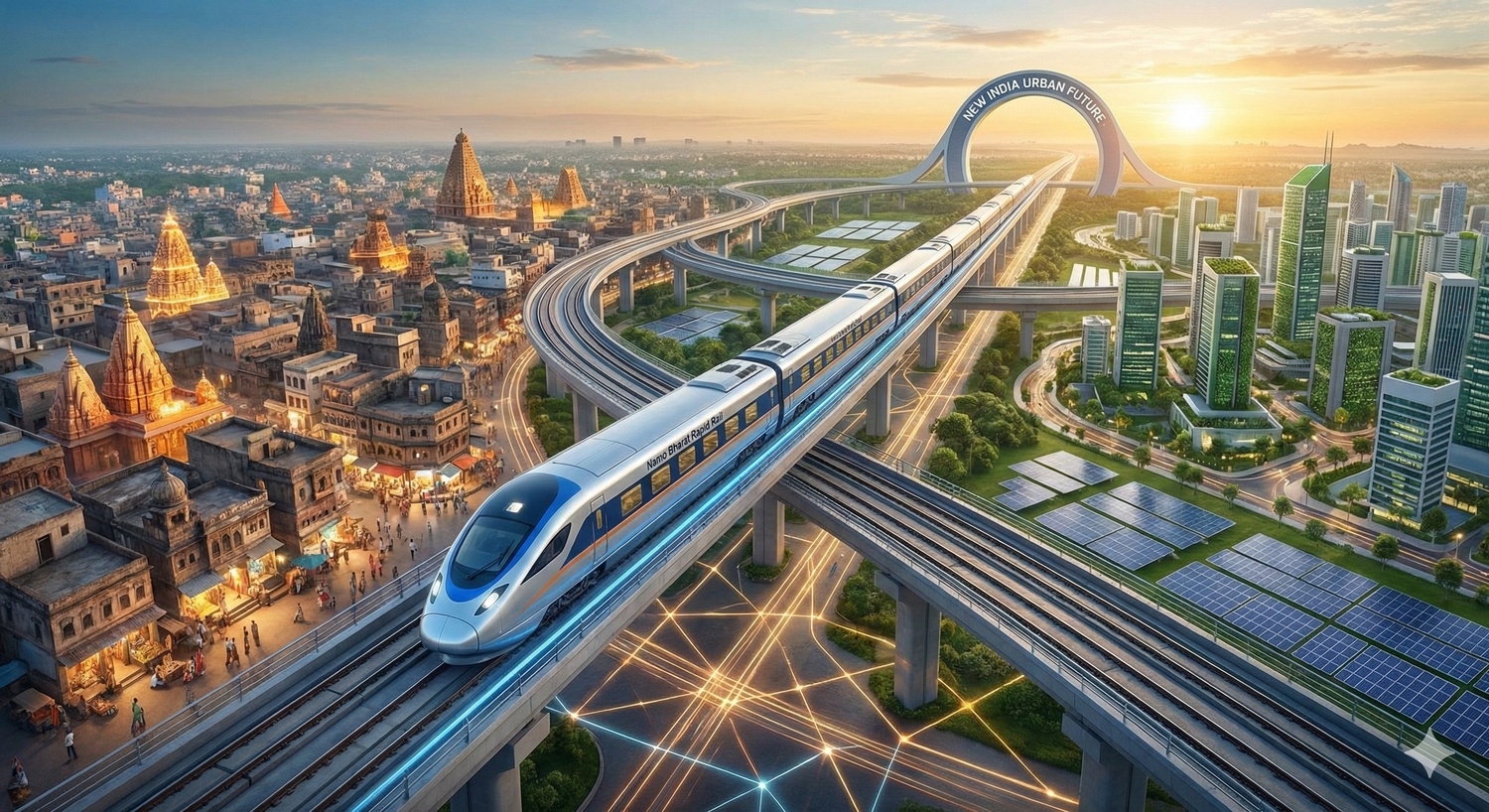
For decades, the Indian commuter had only two real choices: the slow, crowded suburban rail for long distances or the efficient but short-range city metro. There was a gaping hole in the middle—a missing link for the millions who lived 50 to 100 kilometers away from major economic hubs but traveled there daily. The launch of the Delhi-Meerut corridor, now known as Namo Bharat, plugged this gap, proving that inter-city commuting could be fast, comfortable, and dignified.
But what started as a solution for the National Capital Region (NCR) is now evolving into a national blueprint.
Recent policy announcements and the latest Economic Survey have signaled a massive shift: the Namo Bharat Rapid Rail is going national. With nearly 2,900 kilometers of potential corridors identified across the country, India is on the brink of a transit revolution that promises to merge distinct cities into massive, unified economic clusters. This is no longer just a railway project; it is an urban re-engineering plan that will redefine where Indians live, work, and invest.
The most striking development is the sheer scale of the proposed expansion. The government has moved beyond the pilot phase in Delhi-NCR and identified key regional clusters across the country that are ripe for the Regional Rapid Transit System (RRTS) model.
The logic is simple: connect a booming metropolis with its satellite towns using a high-speed rail spine that operates at 160 km/h. This effectively shrinks the travel time between cities from hours to minutes.
While the NCR continues to expand with the Delhi-Gurugram-SNB-Alwar and Delhi-Panipat corridors, the real excitement lies in the southern and western markets. The Economic Survey has flagged potential corridors such as Bengaluru-Mysuru-Tumakuru-Hosur, Chennai-Vellore-Villupuram-Chengalpattu, and Hyderabad-Warangal. Even Kerala is looking to adopt this model with a proposed Thiruvananthapuram-Kasaragod corridor.
These aren't just lines on a map; they represent the creation of "Mega-Regions." For instance, a rapid rail link between Bengaluru and Mysuru would allow a tech worker to live in the heritage city of Mysuru, enjoy a lower cost of living, and commute to their office in Electronic City in under an hour. It fundamentally breaks the chokehold of density that currently plagues India’s Tier-1 cities.
The expansion of Namo Bharat is driven by the economic necessity of "decongestion through connectivity." Our metro cities are saturated. Real estate is unaffordable, traffic is gridlocked, and pollution is rampant. The RRTS model offers a release valve.
By enabling high-frequency, high-speed travel, the system expands the labor market radius. A business in Hyderabad can now hire talent from Warangal without asking them to relocate. This leads to a more balanced distribution of economic wealth. Instead of all development clustering within the Ring Road, it spreads out along the corridor.
We are already seeing the "Namo Bharat Effect" in Uttar Pradesh. The operational Delhi-Meerut line has not only reduced travel time but also generated millions of man-days of employment during its construction. More importantly, it has opened up access to over 7 lakh jobs for residents of Meerut who can now reach the capital in less than 60 minutes. Replicating this success in industrial belts like Chennai-Vellore could skyrocket regional productivity.
For investors and homebuyers, the nationwide expansion of RRTS is arguably the biggest signal in a decade. Infrastructure has always been the primary driver of real estate appreciation, and the Namo Bharat corridors are proving to be potent catalysts.
In the NCR, property markets in Ghaziabad, Modinagar, and Meerut have witnessed a sharp correction—upwards. Areas that were once considered "too far" are now premium hotspots. With the announcement of new corridors, a similar trajectory is expected in towns like Tumakuru, Hosur, and Warangal.
The emerging trend is the "Rent-to-Own" pipeline. Young professionals, priced out of core city markets, are increasingly willing to buy larger homes in satellite towns, provided the connectivity is reliable. Recent surveys indicate that a vast majority of commuters are willing to invest in properties near RRTS stations. This suggests that the next real estate boom won't be in the city centers, but in the "nodes" created by these rapid rail networks.
Developers are already taking note, with plans for integrated townships and Transit-Oriented Development (TOD) zones mushrooming around proposed stations. These aren't just dormitory towns; they are being planned as self-sustaining ecosystems with offices, malls, and schools, anchored by the rapid rail station.
Beyond economics and real estate, the Namo Bharat expansion is a critical component of India’s climate strategy. The shift from road to rail is essential to bringing down carbon emissions. By taking thousands of private vehicles off the highways daily, these corridors act as "green lungs" for the region. The trains themselves are energy-efficient, and the infrastructure is designed to minimize environmental impact.
There is also a profound social dimension to this expansion. The safety and reliability of the Namo Bharat system have proven to be a game-changer for women commuters. With features like reserved coaches, CCTV monitoring, and well-lit stations, it encourages higher female workforce participation, allowing women to travel longer distances for work without the safety concerns associated with other modes of transport. Notably, the operations of the current Namo Bharat trains see significant involvement from women staff, setting a benchmark for gender inclusivity in the transport sector.
The vision of a connected India is moving from the drawing board to the ground. The transition from "planning" to "execution" for these new corridors will require intense coordination between state governments and the center, particularly regarding land acquisition and funding. However, the template has been set. The successful operationalization of the first phase in NCR has silenced skeptics and provided a working model for the rest of the country.
As the network expands, the definition of what constitutes a "city" will blur. We will stop seeing Bengaluru and Mysuru as two separate entities and start seeing them as one economic powerhouse linked by a steel spine. The Namo Bharat Rapid Rail is not just a train; it is the vehicle that is driving India towards a future of decentralized, sustainable, and equitable urban growth. The age of the "Super-Region" has arrived.
