Published On:
May 3, 2026
Updated On:
May 3, 2026
Modern real estate investors are aggressively transitioning away from passive, generation-spanning property holding, opting instead for data-driven, cyclical investing strategies that align with medium-term financial goals and broader portfolio diversification.
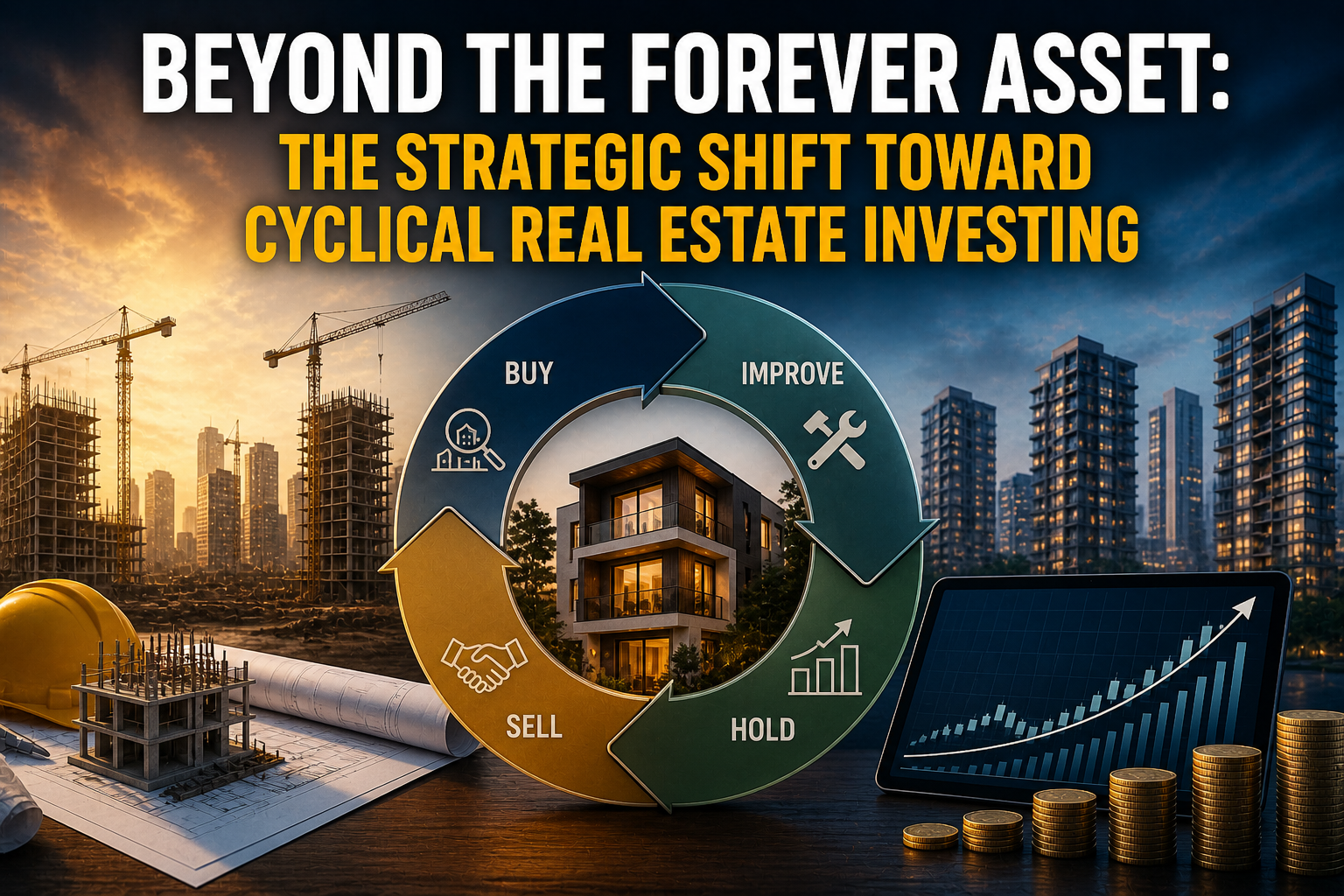
For generations, the golden rule of property investment was undisputed: buy early, hold indefinitely, and let the passage of time perform the heavy lifting. Real estate was universally treated as a patient, almost immovable asset class. Families would secure plots of land on the expanding peripheries of growing cities and simply wait—often for decades—for urban development to eventually catch up. Houses and commercial spaces were passed down through generations as permanent wealth anchors. The overarching emphasis was placed entirely on permanence rather than strategic timing.
However, the modern property landscape is experiencing a massive, fundamental transformation. A younger, highly financially literate demographic of investors is completely rewriting the rulebook, moving aggressively away from passive inheritance toward purposeful, cyclical real estate investing. This subtle but profound psychological shift marks the transition from passive ownership to an active, highly disciplined investment strategy.
In the past, the severe lack of market transparency and real-time data made holding property long-term the only viable risk-mitigation strategy. Investors essentially parked their capital and forgot about it, relying on the assumption that property values always ascend over a long enough horizon. While this approach undeniably built tremendous generational wealth for many, it was inherently rigid. Capital was permanently locked away, completely unavailable for redeployment into newer, potentially more lucrative opportunities. The core assumption was that holding an asset longer was universally and unconditionally preferable.
This legacy mindset is rapidly fracturing. The contemporary investor still profoundly values the stability, inflation-resistance, and tangible nature of real estate, but they no longer view it as a mandatory forever asset. Instead, the market is witnessing the rise of cycle-based thinking. Property buyers are now entering the market with highly defined entry points, structured holding periods, and precise exit strategies.
The primary catalyst driving this psychological shift is the deep exposure modern investors have to agile financial markets. Today’s property buyers are highly accustomed to trading equities, navigating mutual funds, and utilizing advanced digital wealth management platforms. Because they are intimately familiar with financial concepts such as portfolio allocation, compounding interest, strategic rebalancing, and opportunity cost, they naturally expect their real estate holdings to operate with a similar level of strategic fluidity.
Property is no longer evaluated in total isolation. It is actively benchmarked against other wealth-building instruments based on anticipated yield, capital liquidity, and concentration risk. Real estate must now mathematically justify not only why it deserves a place in an investment portfolio, but exactly when it should be acquired, how long the capital should remain tied up, and when those funds should be liquidated and rotated into a better-performing asset.
What exactly does it mean to treat property cyclically? At its core, cyclical real estate investing involves recognizing that local property markets breathe in four distinct, highly predictable phases: recovery, expansion, hyper-supply, and recession. Rather than buying blindly and hoping for the best, modern investors are actively analyzing these phases to heavily optimize their capital deployment.
During the recovery phase, a localized market typically experiences high vacancy and low demand, but prices have firmly bottomed out. This represents a prime entry point for visionary investors. As the market naturally transitions into the expansion phase—often triggered by declining vacancy rates and new civic construction—property values surge aggressively.
When a market eventually reaches hyper-supply, an overabundance of new construction creates increased vacancy, and rent growth abruptly slows. Finally, the recession phase brings price drops and market stagnation. A cyclical investor does not simply hold an asset blindly through a recession. Instead, they execute a planned exit during the late expansion or early hyper-supply phases, liquidating the property to capture the maximum capital gain. The freed-up liquidity is then strategically rotated into a completely different geographical market that is just beginning its own recovery trajectory.
In decades past, successfully timing the property market was largely considered a myth or a massive gamble, heavily reliant on opaque broker networks, local hearsay, and gut intuition. Today, the democratization of real estate data has fundamentally altered the playing field. The rapid rise of advanced prop-tech platforms, digital land registries, and comprehensive market analytics tools has granted retail investors unprecedented visibility.
Modern buyers can instantly access highly granular data regarding historical price trends, shifting rental yields, localized vacancy rates, and massive transaction volumes. When an investor can mathematically track the exact absorption rate of new housing inventory in a specific suburb, their investment thesis shifts from speculative guessing to highly calculated strategy. This wealth of information empowers investors to evaluate opportunities with extraordinary context, identifying exactly where a local market sits within the broader economic cycle.
Savvy real estate participants understand that property values do not operate in a vacuum; they are deeply tethered to broader macroeconomic forces. Consequently, tracking these large-scale economic indicators is a crucial component of cyclical property investing. Investors are increasingly recognizing that global and national economic shifts directly dictate local property cycles.
Interest rates established by central banks are perhaps the most immediate trigger. In a low-interest-rate environment, the cost of borrowing drops significantly, heavily stimulating mortgage demand and driving property prices upward during an expansion phase. Conversely, when inflation surges, central banks are forced to hike interest rates to cool the broader economy. This inevitably kills mortgage affordability, creating a severe cooling effect on the real estate market.
While property has historically acted as a reliable hedge against inflation, unmanageable inflation inevitably triggers the high-interest rates that stall market momentum. By closely monitoring these inflation trends, regional credit conditions, and local employment cycles, cyclical investors can accurately forecast impending market shifts, allowing them to adjust their entry and exit strategies long before the general public reacts to the changing economic climate.
The transition from passive holding to active strategy has introduced a massive wave of intentionality into the property sector. Investors are no longer committing capital with open-ended, vague expectations. Instead, real estate acquisitions are being intricately linked to highly specific, medium-term financial objectives.
A modern investor might acquire a commercial retail space with the strict objective of generating high-yield rental income over a defined five-year period. Alternatively, they might purchase a residential plot in a developing suburban corridor with a seven-year timeline for aggressive capital growth. By establishing these defined investment horizons, property owners create immense financial flexibility. If a local market overheats early or drastically underperforms due to shifting municipal policies, the investor possesses a predefined framework that allows them to objectively reassess the asset's performance, quickly liquidate the holding, and redeploy their capital without the paralyzing emotional attachment that frequently plagued previous generations of homeowners.
The traditional approach to property investment frequently involved taking a massive portion of a family's accumulated wealth and concentrating it entirely into a single, high-value residential asset. While this strategy occasionally paid off over several decades, it exposed the investor to severe geographic concentration and massive illiquidity risk. If that specific neighborhood fell out of favor, or if local infrastructure projects stalled indefinitely, the family's entire net worth stagnated.
Cyclical investing completely dismantles this highly risky concentration. Modern property portfolios are built on the foundational principle of balanced allocation. Rather than sinking vast sums into one immovable asset, today's investors strongly prefer maintaining smaller, highly strategic exposures across multiple geographic markets and varying asset types.
Furthermore, the rise of modern financial vehicles like Real Estate Investment Trusts has allowed investors to participate in cyclical market movements without the heavy burden of physically managing a property. A well-constructed cyclical portfolio might include a fractional ownership stake in a commercial IT park via a trust, a physical residential apartment in a booming tier-two city, and agricultural land positioned along a proposed industrial highway. This aggressive diversification drastically reduces dependence on any single economic outcome and ensures that the investor is always positioned to capitalize on multiple, independent growth cycles.
It is highly critical to draw a sharp, definitive line between cyclical real estate investing and short-term market speculation. Speculation is inherently risky, relying on the aggressive prediction of immediate, erratic price movements in the hopes of securing a quick, massive profit through property flipping. Speculators frequently ignore underlying economic fundamentals, betting entirely on short-lived market momentum.
Cyclical investing, conversely, is deeply grounded in patience, research, and discipline. An investor who deliberately chooses to purchase commercial land precisely before a major transit corridor becomes active, and then patiently holds that asset for six years until the region fully matures before exiting, is not speculating. They are deliberately and methodically managing their capital to capture a specific, verifiable phase of economic value creation. Timing the market, in this sophisticated context, is not about chasing the absolute perfect, elusive moment to buy at the absolute bottom or sell at the absolute peak. It is about understanding the broader rhythm of the market, identifying structural growth drivers, and treating property as an active, deliberate financial decision.
To truly grasp how cyclical real estate investing operates in reality, one must look at how massive civic infrastructure dictates regional property cycles. Across the highly active northern real estate markets, the absolute most reliable trigger for a massive, multi-year property expansion cycle is the development of heavy transit and industrial infrastructure.
Consider the massive economic cycles generated by expansive mega-projects in the National Capital Region. When a state government formally announces the acquisition of land for an international aviation hub or a massive industrial expressway, it instantly triggers the initial phase of the investment cycle. At this early stage, institutional investors and highly strategic retail buyers enter the market, acquiring raw land or early-stage commercial plots at relatively low baseline valuations.
As the earthmovers arrive and the physical construction of these massive corridors—such as the highly publicized regions governed by the Yamuna Expressway Industrial Development Authority or the expansive transit nodes connecting to Greater Noida—begins to take shape, the local micro-market enters a rapid, highly aggressive expansion phase. Property values begin to surge exponentially as multinational corporations secure warehousing logistics space, and large-scale developers launch integrated residential townships to house the incoming corporate workforce.
A passive, traditional investor would simply hold their property in these regions forever, eventually seeing their annual returns plateau once the airport is fully operational and the surrounding city is completely built out. A cyclical investor, however, recognizes exactly when the infrastructure premium has been fully priced into the local market. They will strategically exit their positions during this stabilization phase, securing massive capital gains. They will then take that newly generated wealth and aggressively hunt for the next emerging infrastructure corridor, effectively surfing the wave of economic development from one region to the next.
The ongoing transition from legacy holding patterns to highly strategic, cyclical real estate investing is not a temporary market fad; it is a permanent, structural evolution in how property wealth is managed. The real estate market has officially matured, becoming exponentially more transparent, highly data-driven, and intrinsically linked to global macroeconomic forces.
For the next generation of property buyers, the concept of passive inheritance is rapidly losing its appeal. The modern investor demands extreme flexibility, uncompromising visibility into market data, and perfect alignment with their broader financial trajectories. They intrinsically understand that while real estate remains one of the most powerful wealth-creation tools on the planet, its true, absolute potential is only fully unlocked when it is managed with the same rigorous discipline and cyclical awareness applied to the broader financial markets. Ultimately, timing the market has evolved from a risky, speculative gamble into a mandatory, highly calculated strategy, permanently changing the landscape of modern property ownership.
