Published On:
March 16, 2026
Updated On:
March 16, 2026
As Gurugram evolves from a rapid-growth corporate satellite into a massive metropolitan hub, its crumbling infrastructure and reactive planning underscore an urgent need for a second urban masterplan. A structured, infrastructure-first approach is essential to resolve traffic gridlocks, housing density imbalances, and civic deficits, ensuring sustainable growth for the future.
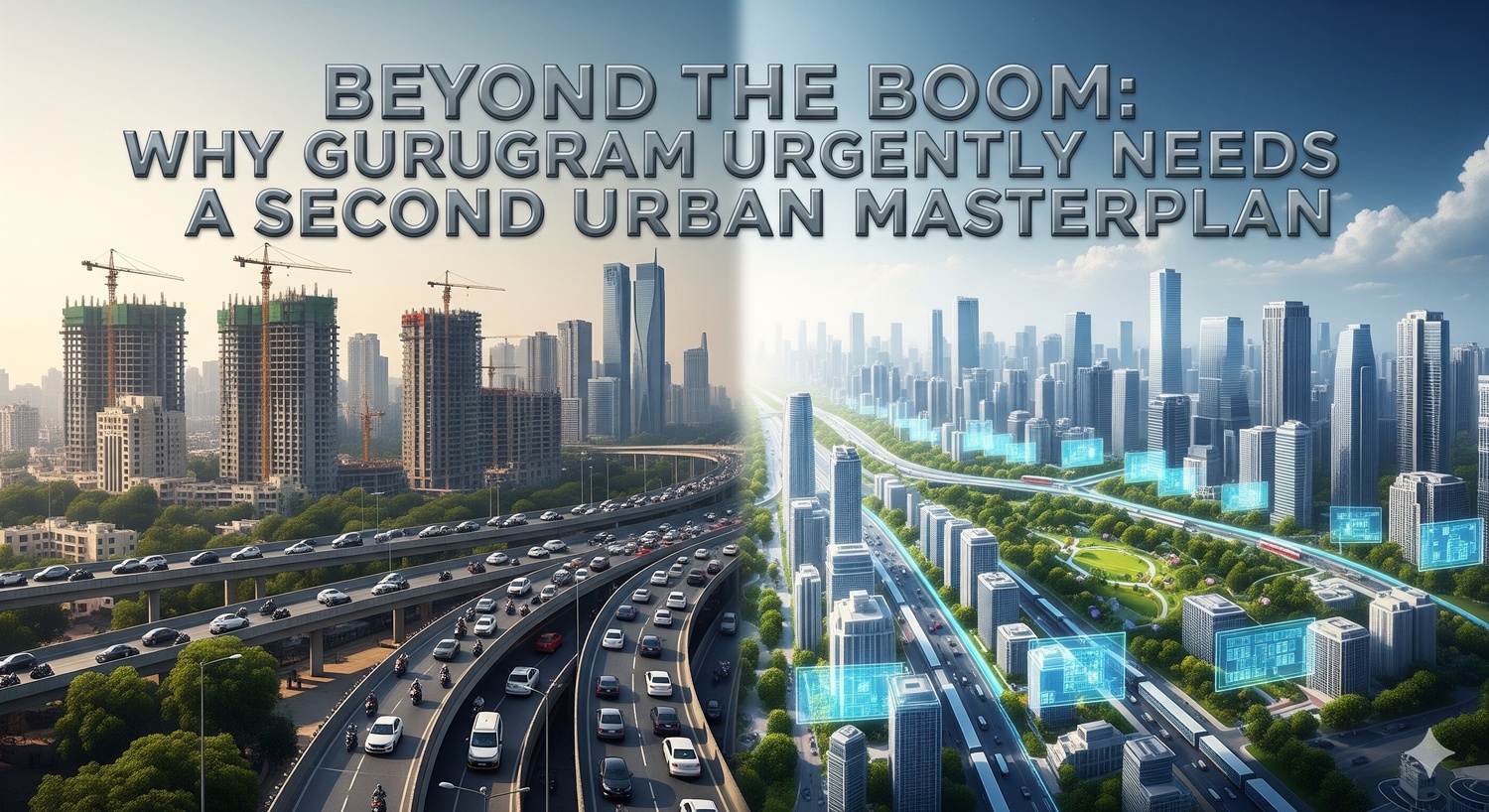
Gurugram's journey over the past three decades is nothing short of extraordinary. What was once a cluster of sleepy villages and agricultural lands on the outskirts of the national capital has rapidly morphed into India's most prominent corporate and financial hub. Today, the city shoulders the economic weight of the National Capital Region (NCR), housing over 2,500 multinational corporate offices and supporting a professional workforce of nearly 1.2 million people. Its skyline, defined by glittering glass facades and towering premium residential complexes, reflects an aggressive trajectory of real estate growth in NCR.
However, the very speed of this transformation has become its biggest vulnerability. Gurugram's rise was largely fueled by a liberalized, private-sector-led development model. While this approach succeeded in building world-class office spaces and luxury townships along key arteries like NH-48, Golf Course Road, and the Southern Peripheral Road, the broader civic infrastructure was left struggling to keep up. The initial phases of agglomeration brought immense economic benefits, but as the city's population surged, the gap between private construction and public utilities widened dramatically. Today, the city stands at a critical juncture where the sheer intensity of its development is clashing with its limited urban capacity.
The consequences of unplanned expansion are now a daily reality for millions of residents and commuters. Traffic congestion, waterlogging, and an overwhelmed public transit system have become synonymous with the Gurugram experience. The city currently has more than one million registered vehicles, with thousands more added to the roads every year. Arterial roads that were designed for a fraction of the current population are now buckling under metropolitan traffic volumes.
The infrastructure challenges are particularly glaring during the monsoon season. Poorly planned drainage networks and a massive increase in impervious concrete surfaces lead to severe waterlogging, bringing the city's corporate engine to a grinding halt. When major intersections and underpasses flood, the resulting traffic gridlocks cause massive productivity leakages. Economic analyses suggest that the loss of man-hours and the operational costs associated with these traffic bottlenecks run into billions of dollars annually.
Furthermore, Gurugram's public transportation system remains heavily under-resourced. Despite ongoing efforts to expand the metro network and introduce more bus routes, the current supply falls drastically short of demand. A comprehensive mobility assessment recently highlighted the need for over 1,500 city buses to cater to the growing population, yet the operational fleet remains just a fraction of that requirement. This over-reliance on private vehicles not only worsens traffic congestion in Gurugram but also contributes significantly to deteriorating air quality, raising serious environmental and public health concerns.
Perhaps nothing illustrates Gurugram's urban planning woes better than the ongoing crisis surrounding the 24-metre internal sector roads. Under the current Gurugram Master Plan 2031, which replaced earlier iterations to accommodate higher population densities, specific guidelines were laid out for road widths. While government agencies were responsible for the massive 60-metre sector-dividing roads, the development of 24-metre internal access roads within newer residential sectors was left to private developers.
This fragmented model has resulted in a chaotic patchwork of infrastructure. Developers are only required to build the portion of the road that falls directly within their licensed land. As a result, many premium housing societies, despite boasting world-class internal amenities, are accessible only via narrow, unpaved village revenue roads or sudden dead ends. In several areas, the promised 24-metre access roads narrow down to a mere three or six metres, leading to daily traffic bottlenecks right outside luxury high-rises.
The root of this issue lies in the transition between older and newer development blueprints. In the early days of Gurugram's development, state authorities actively acquired land and built internal road networks before handing them over for residential use. However, in the rapid expansion phase over the last two decades, this proactive land acquisition took a backseat. The responsibility shifted, but the mechanisms to acquire contested land strips between different private plots were never fully realized. Although transferable development rights policies were introduced to incentivize landowners to surrender land for road construction, they failed to yield the desired results. Consequently, thousands of families moving into newly delivered apartments face severe connectivity and safety hazards, underscoring the deep flaws in the current regulatory framework.
A significant contributor to the uneven density across the city has been the near-total absence of major government-led sector development for almost twenty years. For a long time, the city's growth has been dictated by where private developers chose to acquire land and launch projects. This market-driven approach naturally favored areas with immediate commercial viability, leading to the hyper-concentration of development in specific corridors like Cyber City, Golf Course Road, and increasingly, the Dwarka Expressway.
While these areas flourished, they also became intensely saturated. The infrastructure in these hotspots is pushed to its absolute limits, while other potential urban zones remain underutilized. The recent realization by state authorities that they need to step back in, acquire large land parcels, and launch new, planned sectors is a welcome shift. It marks a crucial recognition that leaving city-building entirely to market forces results in a skewed urban landscape. Government intervention is required not just to provide structured land parcels, but to ensure that the foundational framework of a city—its roads, sewers, power grids, and public spaces—is laid down symmetrically and logically.
To sustain its trajectory as India's premier corporate and real estate destination, Gurugram cannot rely on piecemeal fixes, temporary bypasses, or reactive road-widening projects. The city desperately needs a comprehensive Gurugram second urban masterplan—a visionary blueprint that transitions the region from a collection of isolated private townships into a cohesive, balanced metropolitan ecosystem.
A new masterplan would fundamentally alter the development paradigm in several critical ways:
First, it would enforce infrastructure-led development. The golden rule of successful urban planning is that public utilities must precede population influx. A revised masterplan would mandate the completion of core Gurugram infrastructure development—such as stormwater drains, power substations, and multi-modal transit corridors—before building licenses are granted for massive residential or commercial hubs. This proactive approach would eliminate the current scenario where residents move in first and wait years for basic approach roads to be built.
Second, a new masterplan would critically address the issue of spatial inequality and density redistribution. By identifying and developing emerging urban zones with robust connectivity, the city can decentralize its economic hubs. Encouraging commercial and residential growth in newer, well-planned sectors would naturally ease the immense pressure on the legacy corridors that are currently suffocating under their own weight.
Third, it would facilitate the implementation of Transit-Oriented Development. As Gurugram anticipates a population surge into the millions over the next two decades, relying entirely on cars is mathematically and environmentally impossible. A forward-looking masterplan must integrate land use with public transport, encouraging high-density, mixed-use developments within walking distance of metro stations and major bus transit hubs. This shift is essential to reduce the carbon footprint of the city and improve overall mobility.
Fourth, it would address environmental sustainability head-on. The ecological balance of the region has been severely compromised by rampant construction. A new masterplan must mandate sustainable urban drainage systems, the protection of natural water recharge zones, and strict guidelines on maintaining green cover. Implementing climate-responsive planning is no longer a luxury but an absolute necessity to prevent the city from becoming unlivable during extreme weather events.
Despite the visible strain on its resources, the city's economic momentum shows no signs of slowing down. Regional industry data consistently shows robust office leasing activity, driven heavily by global capability centers, tech firms, and financial institutions flocking to the area. The real estate market remains incredibly buoyant, with property values along new infrastructure corridors witnessing unprecedented appreciation.
This sustained demand proves that Gurugram has successfully established itself as an indispensable economic engine. However, cities that grow at such breakneck speeds eventually face a plateau if their liveability index drops too low. High-earning professionals and global corporations are increasingly prioritizing quality of life, environmental health, and seamless commutes when choosing their bases. If the daily friction of living and working in the city becomes too high due to infrastructural collapse, the very talent and investment that built the city could begin to migrate elsewhere.
The story of Gurugram is a fascinating case study in rapid urbanization. It showcases the incredible power of private enterprise in building economic hubs from the ground up, but it also serves as a stark warning about the limitations of agglomeration without comprehensive civic planning.
The city has reached a definitive turning point. The focus can no longer be solely on how many millions of square feet of real estate can be added each year; it must shift to how well those spaces are integrated into a functioning, breathable city. The initiative to resume government-led land acquisition for vital roads and new sectors is a positive step, signaling a return to structured city management.
However, these efforts must be consolidated under a sweeping, modernized masterplan. Gurugram needs a second urban masterplan that reflects its current reality as a global metropolis rather than a mere suburb. This blueprint must bridge the gap between private luxury and public utility, ensuring that the wealth generated within the city's corporate towers translates into well-paved roads, reliable transit systems, and a clean environment for all its residents.
The next chapter of evolution must be defined by deliberate, balanced, and sustainable planning. By pausing to redesign its trajectory and committing to an infrastructure-first philosophy, Gurugram can secure its position not just as a center of rapid growth, but as a resilient, world-class city ready for the decades to come.
