Published On:
February 5, 2026
Updated On:
February 5, 2026
The recent easing of trade tariffs between India and the US in February 2026 is poised to be a silent but powerful catalyst for the Indian real estate sector. By reducing operational barriers and boosting investor confidence, this development is expected to accelerate the expansion of Global Capability Centers (GCCs), drive industrial warehousing demand, and indirectly fuel the luxury housing market through increased economic stability.
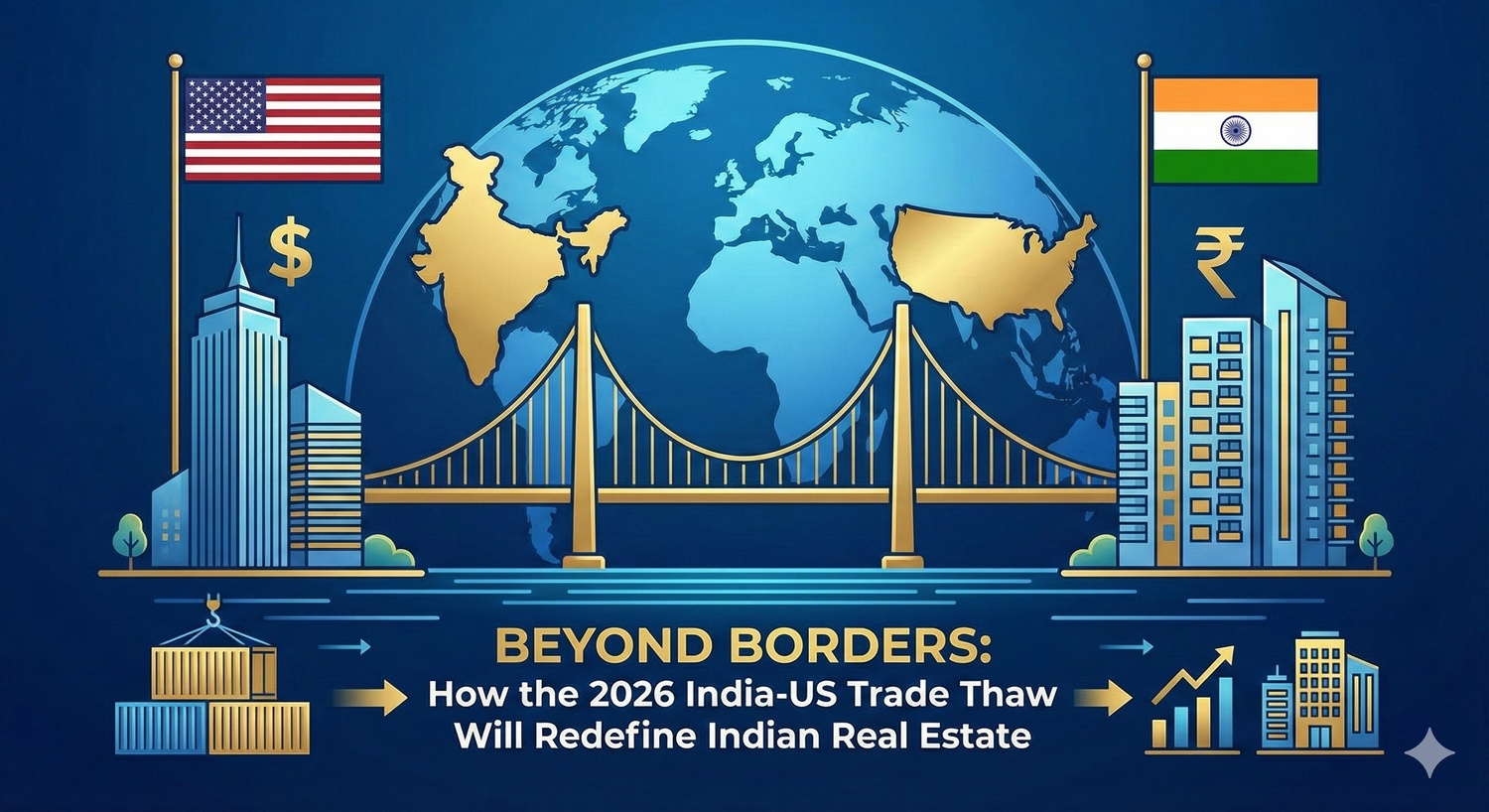
In the complex machinery of the global economy, a policy shift in Washington often turns the gears of development in Mumbai, Bengaluru, and Gurugram. The recent breakthrough in India-US trade relations—specifically the February 2026 agreement to rationalize tariffs—has dominated financial headlines. But while the immediate applause is reserved for exporters of textiles, gems, and engineering goods, a more structural transformation is brewing in a sector that rarely gets mentioned in trade treaties: Real Estate.
For years, the relationship between international trade and local property markets has been viewed through a narrow lens. However, the reduction of reciprocal tariffs to 18% and the broader commitment to removing non-tariff barriers is not just a win for commodities; it is a green light for corporate expansion. When trade friction decreases, capital flow increases, and capital needs space—offices to house talent, warehouses to store goods, and data centers to process information.
This blog explores the ripple effects of this strengthened bilateral tie and why real estate investors should look beyond the obvious to understand the long-term impact on India’s built environment.
The most direct beneficiary of improved India-US ties is the Commercial Office sector, specifically the Global Capability Centers (GCCs). GCCs have evolved from being mere back-office support units to strategic innovation hubs for multinational corporations.
With US-based companies already accounting for a staggering majority—nearly 75%—of the demand for GCC space in India, any policy that reduces the cost of doing business is a force multiplier. The reduction in tariffs improves the profit margins of these US parent companies, freeing up capital for expansion. Industry projections suggest that the number of GCCs in India could cross 2,400 by 2030.
The trade thaw acts as a confidence booster. We are likely to see a "flight to quality," where American firms, emboldened by a stable trade regime, commit to larger, longer-term leases in Grade-A office parks. This demand will not be limited to the traditional tech corridors of Bengaluru and Hyderabad but will likely spill over into Pune and Chennai as firms seek to diversify their operational footprints.
If office spaces are the brain of this economic relationship, the industrial and logistics sector is the spine. A trade deal that aims to boost the export of physical goods—from auto components to pharmaceuticals—necessitates a robust infrastructure to store and move these products.
The "China Plus One" strategy has already put India on the map for US manufacturing supply chains. This new tariff rationalization makes Indian exports more competitive against rivals like Vietnam and Bangladesh. As production ramps up to meet American demand, the requirement for Grade-A warehousing and industrial parks is set to skyrocket.
We anticipate a surge in demand for Third-Party Logistics (3PL) facilities, particularly near port cities and along major industrial corridors like the Delhi-Mumbai Industrial Corridor (DMIC). This is no longer just about storage; it is about high-spec, automated fulfillment centers capable of handling the increased velocity of trade. For real estate developers, land parcels in these logistics nodes are becoming goldmines.
While trade deals rarely mention housing, the correlation is undeniable. The residential real estate market, particularly the luxury and premium segments, is deeply tethered to general economic sentiment and the "Wealth Effect."
When export-oriented sectors (like IT, textiles, and pharma) perform well due to lower tariffs, it leads to wealth creation for business owners, senior executives, and employees holding stock options. This liquidity invariably finds its way into real estate assets.
Furthermore, a stable trade relationship strengthens the Indian Rupee and mitigates currency risks, making India a more attractive destination for Non-Resident Indians (NRIs) based in the US. NRI investment in Indian real estate has historically spiked during periods of strong bilateral ties. We can expect renewed interest in luxury condominiums and vacation homes, not just as emotional investments but as prudent financial assets underpinned by a growing economy.
One of the most exciting sub-trends is the democratization of development. The cost benefits of the trade deal, combined with the saturation of metro cities, are pushing US firms to look at Tier-2 cities for their next phase of growth.
Cities like Jaipur, Indore, Coimbatore, and Kochi are emerging as viable hubs for GCCs and manufacturing units. These cities offer a dual advantage: lower operational costs for US firms and a lower cost of living for employees. As American capital flows into these regions, it triggers a cycle of development—better offices lead to better retail infrastructure, which in turn fuels demand for quality housing. The trade deal effectively acts as a catalyst for urbanizing "Bharat," creating micro-markets that offer higher rental yields than the established metros.
Modern trade is as much about data as it is about physical goods. The focus on technology transfer, AI, and semiconductor cooperation in the India-US dialogue translates into a massive need for digital infrastructure.
US tech giants are the primary occupiers of data center capacity in India. With cross-border data flows expected to increase, the demand for hyper-scale data centers is projected to rise. Real estate developers venturing into this specialized asset class stand to gain significantly. This is infrastructure-heavy real estate that requires long-term capital, exactly the kind that follows long-term trade stability.
It is easy to dismiss a trade tariff adjustment as a purely macroeconomic event with little relevance to the property buyer or developer. However, real estate is a derived demand—it grows where the economy grows.
The 2026 easing of India-US trade tensions provides the structural stability required for long-term investments. It reassures global occupiers that India is a partner of choice, not just for today, but for the decade. For the Indian real estate sector, this doesn't just mean filled office buildings; it means a more mature, resilient, and globally integrated market. The impact may be silent at first, but the foundations being laid today will support the skyline of tomorrow.
