Published On:
April 27, 2026
Updated On:
April 27, 2026
The June 30 opening of the Agra Inner Ring Road Phase 3 will permanently reshape the city's transit and real estate landscape, establishing a high-speed, signal-free corridor that connects major national expressways and triggers a massive property boom along the Gwalior highway.
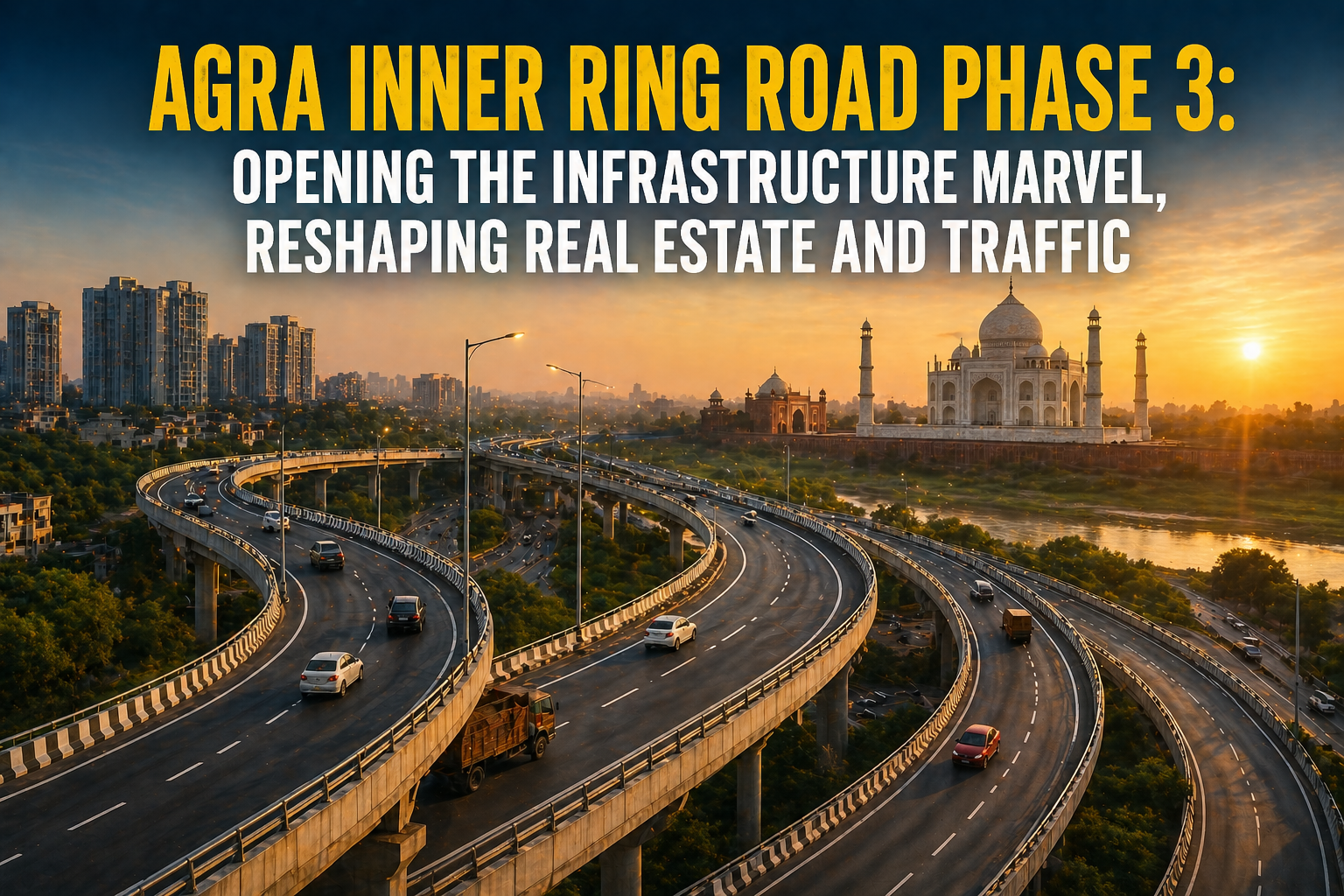
For decades, the city of Agra has lived a double life. On the global stage, it is India’s most recognizable heritage capital, drawing millions of domestic and international tourists to the majestic white marble of the Taj Mahal. On the ground, however, daily life for local residents and interstate commuters has been defined by something entirely different: relentless, suffocating traffic. The heritage city's narrow, winding historical streets were never designed to handle the crushing weight of modern logistics, heavy commercial trucks, and endless streams of intercity buses.
For years, the dream of a seamless bypass seemed like an administrative mirage. That is entirely changing now. The Agra Inner Ring Road Phase 3 is officially entering its final countdown, with a firm public opening date set for June 30, 2026. This is not just another road paving project; it is a structural redesign of how traffic flows through Northern India. By entirely bypassing the city center and creating a high-speed loop around Agra’s southern periphery, the government has essentially moved the commercial heart of the region. For local homeowners, daily commuters, and savvy real estate investors watching the market, this represents the most significant and lucrative infrastructure update the city has witnessed in over a decade.
To understand the sheer magnitude of this upcoming opening, one must look at the larger master plan. The entire Agra Inner Ring Road was conceived as a comprehensive twenty-four-kilometer loop designed to catch highway traffic before it could infiltrate the city limits. While the earlier phases successfully connected the Yamuna Expressway and the Fatehabad Road regions, the southern loop remained incomplete, forcing thousands of vehicles back into the urban grid.
Phase 3 is the critical final puzzle piece. This specific eight-kilometer stretch is an engineering feat executed by the National Highways Authority of India at an estimated cost of roughly four hundred crore rupees. It is a highly advanced, six-lane access-controlled highway that forms a direct, unbroken link between Deori Road and the Gwalior Highway, officially known as NH-44.
The construction teams are currently operating at a fever pitch to meet the June deadline. A significant focal point of this final push is the massive Gutila bridge, where complex engineering work is in its absolute final stages. Safety trials and load-bearing tests are slated to begin by mid-June. Once the final layers of premium bitumen are laid and the safety audits are cleared, the barriers will be lifted, unleashing a new era of connectivity for the entire region.
The immediate, day-one impact of the Phase 3 opening will be felt by anyone who has ever tried to navigate the notoriously congested Mahatma Gandhi Road or Fatehabad Road during peak hours. Currently, any commercial truck or tourist fleet traveling from Delhi or Lucknow with a destination toward Gwalior, Madhya Pradesh, or further south has no choice but to carve a path through Agra’s internal streets. This forces massive, heavy-duty vehicles to share tight lanes with local two-wheelers, e-rickshaws, and pedestrians.
The new ring road fundamentally erases this conflict. By providing a dedicated, signal-free peripheral path, the highway is expected to instantly divert upwards of thirty thousand vehicles away from the city center every single day. For the interstate traveler, this is a massive victory in transit efficiency, slashing travel time between the northern expressways and the southern Gwalior route by a staggering forty-five minutes.
For the local Agra resident, the benefits are equally profound. The internal roads will be handed back to the community. The constant roar of heavy diesel engines echoing off historical monuments will fade, the terrifying bottlenecks at major city intersections will dissolve, and the daily school and office commute will become exponentially safer and more predictable.
The true economic power of the Inner Ring Road lies in its ability to stitch together India’s most vital transit corridors. Agra is geographically positioned at a critical crossroads of the subcontinent. However, without a unifying ring road, the major highways terminating near the city operated in isolation.
Phase 3 changes this dynamic completely. It acts as a massive interchange, seamlessly tying together the Yamuna Expressway coming from the National Capital Region and the Agra-Lucknow Expressway stretching from eastern Uttar Pradesh. By linking these two massive, high-speed corridors directly to the NH-44 Gwalior route, the project creates an unprecedented growth triangle.
Supply chain managers and national logistics firms are already recalculating their transit times. Freight moving from the manufacturing hubs of Noida and Greater Noida can now bypass the National Capital Region's borders, sail down the Yamuna Expressway, loop around Agra without touching a single city traffic light, and head straight down into central and southern India. This frictionless movement reduces fuel consumption, cuts down on vehicle wear and tear, and vastly improves delivery turnaround times, making Agra an undisputed kingpin in North-South logistics.
What makes the June 30 opening uniquely fascinating for long-term urban planners is how it integrates with future infrastructure. Phase 3 is not just the end of the Inner Ring Road project; it is simultaneously the beginning of something much larger.
The junction at Deori village, a key node on this new stretch, has been strategically designed to serve as the primary entry and exit point for the highly anticipated Agra-Gwalior Greenfield Expressway. This upcoming mega-highway is slated to further compress travel times and elevate the region's transit capabilities to global standards. Because the Phase 3 junction at Deori will act as the master interchange for this future greenfield project, the surrounding land is transitioning from a quiet suburban outpost into a high-stakes super-hub. The dual connectivity offered by the existing expressways and the future greenfield corridor ensures that this specific geographical pocket will remain at the forefront of national infrastructure development for decades to come.
Infrastructure and real estate are inextricably linked, and the property market along Agra’s southern periphery is currently experiencing a massive upward trajectory. The impending inauguration of Phase 3 has served as a starting gun for a frantic real estate race, with institutional investors and individual homebuyers rushing to secure their footprint before the official ribbon-cutting ceremony solidifies the new price benchmarks.
The transformation of micro-markets like Rohta and the areas flanking Deori Road is nothing short of spectacular. Just a few years ago, these zones were predominantly characterized by quiet agricultural land and scattered, unorganized settlements. Today, they are morphing into the city’s most promising organized urban hubs. Reputed real estate developers have aggressively scouted and acquired large land parcels, drawing up master plans for expansive gated communities, luxury villas, and premium high-rise apartments.
The financial data backing this boom is highly compelling. Market experts tracking the Agra property sector have noted that residential and commercial plots situated near the new Phase 3 interchanges have witnessed an astonishing price appreciation of nearly twenty percent in the last quarter alone. This is a staggering rate of growth that vastly outpaces the traditional property markets within the older city limits. Buyers are acutely aware that once the highway is fully operational and the heavy machinery clears out, the premium on these properties will jump even higher.
The residential sector is just one side of the coin. The commercial real estate and rental markets in southern Agra are bracing for a massive influx of demand.
With the region solidifying its status as a logistics super-hub, massive tracts of land are being rezoned for commercial use. Warehousing giants, cold storage operators, and e-commerce fulfillment centers are actively seeking large-scale spaces along the new ring road. They understand that placing their distribution centers near the Deori junction guarantees frictionless access to Delhi, Lucknow, and Central India.
This commercial explosion directly fuels the local rental market. Setting up and managing these massive logistics and commercial hubs requires a vast workforce, ranging from warehouse floor managers to senior transport executives and supply chain analysts. These professionals require high-quality, modern housing close to their workplaces. Consequently, the demand for well-maintained rental flats and independent floors in the newly developed gated societies near the ring road is expected to skyrocket. Investors purchasing properties in these new sectors are not just betting on capital appreciation; they are positioning themselves to capture highly lucrative, long-term rental yields from a stable, corporate demographic.
One of the primary reasons buyers are flocking to the southern corridor is the stark contrast in living standards compared to the legacy neighborhoods of Agra. The heritage parts of the city, while culturally rich, suffer from the unavoidable limitations of ancient urban planning. Narrow alleys, severely strained drainage systems, and a complete lack of parking infrastructure make daily modern life incredibly challenging.
The zones developing alongside the Phase 3 Ring Road offer an entirely different reality. This new expansion is being heavily guided by smart-city principles. Prospective homebuyers are being offered wide, well-lit arterial roads, scientifically planned underground drainage networks, and reliable power infrastructure. Furthermore, urban planners have mandated the inclusion of extensive green belts and dedicated public parks alongside the highway developments to ensure the air quality remains superior to the city center.
The integration of digital traffic management systems along the new highway ensures that the adjacent residential sectors remain orderly and safe. For families looking for a modern, uncluttered lifestyle without leaving the city they call home, this southern corridor presents a rare and highly coveted luxury.
Beyond the immediate economic and transit benefits, the completion of the Inner Ring Road holds profound environmental implications for Agra. The city’s air quality has long been a subject of national and international concern, primarily due to its potential impact on the pristine white marble of the Taj Mahal.
Stop-and-go traffic is one of the most severe contributors to localized vehicular pollution. When thousands of heavy trucks are forced to idle at city intersections, the concentration of exhaust fumes spikes dramatically. By rerouting this massive volume of heavy-duty traffic to the periphery and allowing them to maintain consistent highway speeds, the localized greenhouse gas emissions within the city bowl will drop significantly.
The Phase 3 opening is a massive step forward in the broader environmental campaign to protect Agra's historical monuments. A smoother flow of traffic on the outskirts means cleaner air in the center, ensuring that the city's heritage remains unblemished for future generations while simultaneously improving the respiratory health of its current residents.
As the June 30 deadline approaches, the energy surrounding the Agra Inner Ring Road is palpable. The government has effectively redrawn the map, shifting the momentum of urban expansion and commercial dominance firmly to the south.
For the daily commuter, the upcoming opening represents the end of an exhausting era of gridlock and the beginning of a fast, predictable journey. For the logistics sector, it is the realization of a highly efficient, integrated national network. But for the real estate investor and the prospective homebuyer, it is a glaring signal.
The window of opportunity to enter this market at a reasonable price point is narrowing by the day. As the final safety checks are conducted on the Gutila bridge and the toll plazas prepare for operation, the speculative phase of this real estate market is coming to an end. The southern corridor, anchored by Deori Road and Rohta, is fast becoming the most premium and strategically vital address in the Agra of tomorrow. Recognizing this shift now, before the highway opens and the new reality sets in, is the key to unlocking the massive potential of Agra's most transformative infrastructure project to date.
