Published On:
September 12, 2026
Updated On:
September 12, 2026
Before paying a PG deposit, tenants must look beyond room aesthetics and thoroughly inspect the property for hidden dangers like structural cracks, illegal floors, faulty wiring, and blocked fire exits. This comprehensive guide details the seven critical building safety red flags every prospective resident should evaluate to ensure a secure living environment.
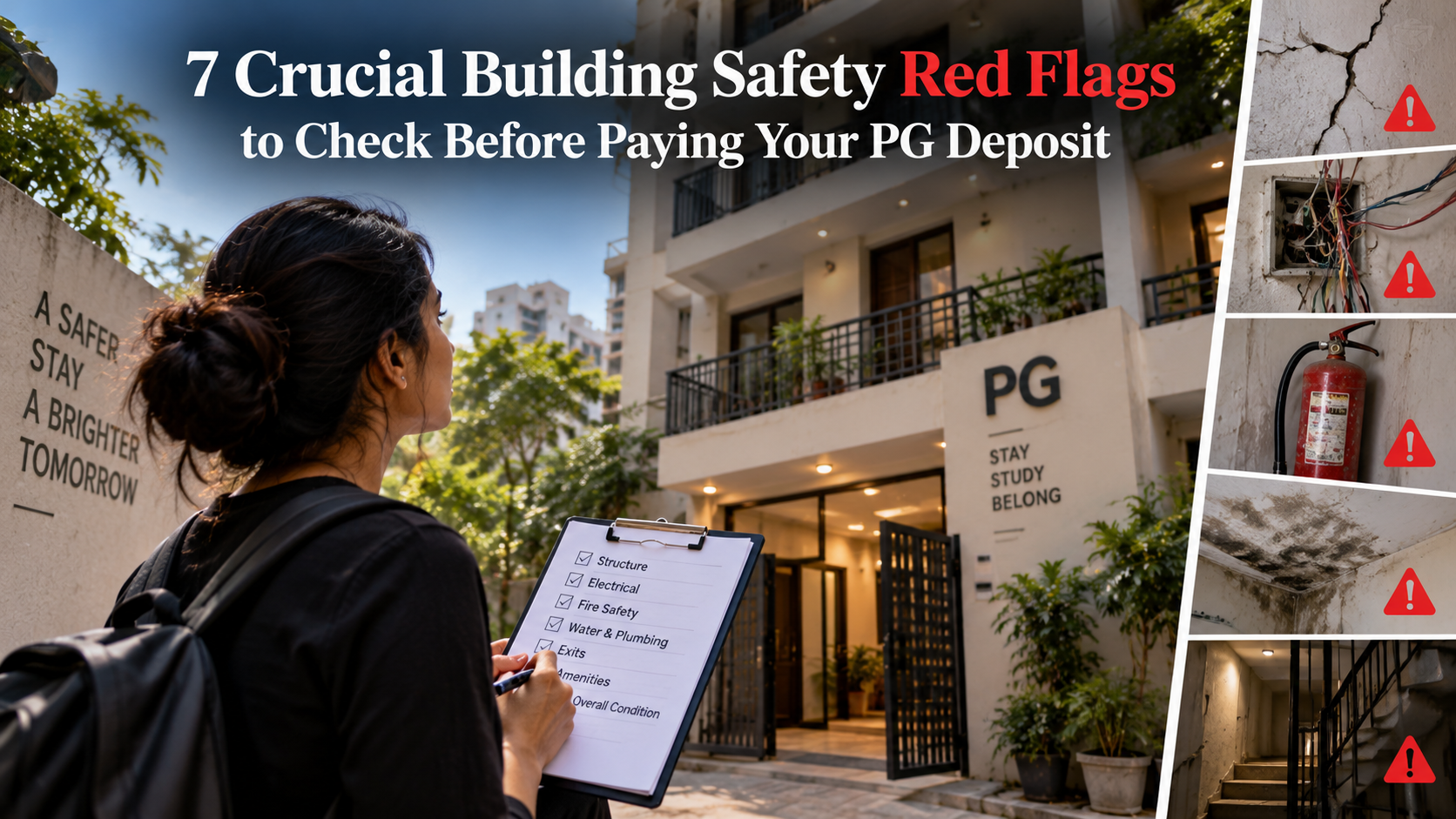
Finding the perfect paying guest accommodation is a major milestone for students and young professionals moving to a new city. Often, the checklist is simple: a reasonable monthly rent, a short walk to college or the office, high-speed Wi-Fi, and decent food. When a property meets these basic needs and the room looks reasonably clean, it is incredibly tempting to pay the PG security deposit right away to lock in the deal. However, this rushed decision can sometimes put your life at risk.
Behind the facade of a freshly painted room and fully furnished interiors, many buildings harbour severe structural and legal hazards. Over the years, urban neighbourhoods have seen independent residential homes rapidly converted into high-density shared rentals. To maximize profits, spaces are arbitrarily partitioned, extra floors are built without permission, and vital safety protocols are ignored. Recent tragic incidents of building collapses and sudden fires during the monsoon season serve as stark reminders that tenant safety cannot be taken for granted.
A fresh coat of paint can easily hide deep foundational cracks, and a stylish false ceiling might mask a sagging concrete slab. Therefore, your property inspection must not stop at the bedroom door. Before you sign the agreement or transfer the booking amount, you need to conduct a thorough physical inspection of the entire premises. Here are seven critical building safety red flags that should make you walk away from a PG accommodation.
When you walk into a paying guest accommodation, the walls might look pristine on the inside, but the true test of structural integrity lies in the building's skeleton. It is vital to distinguish between minor cosmetic flaws and serious foundational damage. Hairline cracks in the plaster are relatively common in older buildings and usually do not pose an immediate threat. However, deep, widening, or diagonal cracks are massive building safety red flags.
Pay close attention to load-bearing elements such as the pillars, columns, ceiling beams, and staircases. A wide diagonal crack, often running at a forty-five-degree angle along a wall or pillar, signals that the building's foundation is settling unevenly or that the structure is overloaded. Another alarming sign is exposed steel reinforcement bars, commonly referred to as rebars. If you can see rusting steel rods peeking through the concrete on the ceiling or balconies, it means the structural integrity of that concrete has been severely compromised by age and corrosion. Furthermore, watch out for sloping floors, widened gaps around window frames, or doors that suddenly jam and refuse to close properly. These are clear indications that the building is undergoing dangerous structural movement and is unsafe for habitation.
In dense urban pockets, space is a premium commodity. To accommodate more students and generate higher monthly rental yields, many PG operators illegally construct additional floors on top of older buildings. A building whose original foundation was designed and approved to support only three storeys might suddenly be carrying the weight of five or six floors. This places immense, unnatural stress on the entire structure.
Before you even step inside the property, stand across the street and look up at the building. Does the top floor look like a recent, hasty addition compared to the rest of the structure? Sometimes, these illegal extensions are built using flimsy prefabricated panels, thin steel frames, or cheap brickwork that lacks proper concrete reinforcement. You might also notice balconies that have been enclosed with makeshift brick walls to create extra sleeping quarters. These unauthorized extensions violate municipal building height restrictions and significantly destabilize the property. Moving into a building that has clearly been extended beyond its permitted capacity is a huge risk, as such structures are highly vulnerable to collapsing during heavy rains or minor seismic activity.
Nobody wants to think about a disaster when moving into a new place, but ignoring fire safety is a gamble you cannot afford to take. High-density paying guest accommodations are particularly susceptible to electrical fires, yet they often lack the most basic evacuation routes. The most common and dangerous layout in converted residential buildings is the reliance on a single, narrow staircase.
Imagine a scenario where an electrical fire breaks out on the ground floor. If the building houses forty to fifty residents and there is only one three-foot-wide staircase, a panicked evacuation becomes a stampede. This risk is heavily compounded when property managers use the staircase landings as storage areas for old furniture, empty cartons, or massive shoe racks, further choking the escape route.
Additionally, check the rooftop access. Many PG operators permanently padlock the terrace doors to restrict access, turning the building into a fire trap. If the lower floors are engulfed in smoke, the terrace is the only upward escape route for rescue. A locked terrace door is an absolute dealbreaker. Lastly, look around the corridors for functional fire extinguishers and ensure they have not passed their expiry dates. The absence of basic smoke alarms, clearly marked exits, and accessible fire safety equipment is a glaring warning sign.
Electrical hazards are arguably the most frequent cause of accidents in shared accommodations. A building that was initially wired for a single family is suddenly forced to bear the load of dozens of residents. With each room running high-tonnage air conditioners, geysers, microwaves, and multiple laptops simultaneously, the ancient electrical wiring is pushed far beyond its safe capacity.
During your visit, look closely at the electrical distribution panels, meter boards, and corridor lighting. Exposed, dangling bundles of wires, especially near wooden staircases or damp walls, are an immediate red flag. Check if the property has proper circuit breakers installed. The absence of a Residual Current Circuit Breaker or an Earth Leakage Circuit Breaker on the main electrical panel is highly concerning. These devices are designed to instantly cut off the power supply in the event of a voltage fluctuation or leakage, preventing fatal electric shocks and massive electrical fires. Furthermore, check the rooms for loose electrical connections, overloaded extension sockets, and scorch marks around switches. If the electrical infrastructure looks like a chaotic, taped-up mess, you should seriously reconsider paying your PG deposit.
Basements have become a highly controversial aspect of student housing safety. To maximize usable space, some PG operators convert underground basements into cramped dormitories, reading libraries, or dining halls. Living or spending prolonged hours in a basement that lacks proper ventilation and dual emergency exits is incredibly dangerous. During the heavy monsoon season, basements can flood rapidly due to poor drainage, posing severe drowning and electrocution hazards. Moreover, the lack of natural light and poor air circulation can lead to severe long-term health and respiratory issues.
Another critical factor to watch out for is ongoing excavation or heavy construction work in the basement or on an immediately adjacent plot. Deep digging right next to an older building can displace the soil supporting its foundation, leading to sudden, catastrophic structural failure. If you notice active structural alterations, heavy machinery excavating the basement, or large-scale knocking down of internal walls while residents are still living in the building, treat it as a massive warning sign. The structural stability of the property is actively being compromised, and it is best to search for an alternative accommodation.
Water is often referred to as the silent destroyer of concrete buildings. While a small leak might seem like a mere inconvenience, persistent water seepage can rot a building from the inside out. Long-term dampness degrades the cement, rusts the internal steel reinforcements, and significantly weakens the load-bearing capacity of the walls and ceilings.
When inspecting a potential room and the common corridors, do not just look at eye level. Look up at the ceilings and down at the skirting boards. Fresh paint cannot completely hide chronic water damage. Look for bubbling or peeling paint, stubborn yellow water stains, or a distinct musty smell that hangs in the air. Bathrooms are a common source of trouble. Check if there is persistent leakage from the floor above or poor drainage that leaves stagnant water pooling in the corners. Heavy dampness and visible mold growth not only compromise the building's structural integrity but also create a highly unhygienic environment that can trigger allergies and asthma. If a property operator has neglected major plumbing leaks for months, it reflects a broader apathy towards building maintenance and resident safety.
The sheer density of occupants in a paying guest accommodation changes the way the entire building functions. An overcrowded PG strains every single utility, from the water supply and sanitation facilities to the electrical load and emergency response capabilities. Pay attention to how the space has been divided. If a standard living room has been partitioned with thin plywood to create three windowless cubicles, the property is being exploited well beyond its permitted capacity.
Overcrowded properties are rarely legally sanctioned. In many cities, operating a commercial PG out of a residential building requires specific municipal approvals, building sanction plans, and a No Objection Certificate from the local fire department. While it might feel awkward, you have every right to ask the PG operator about these documents. A property manager who becomes defensive, refuses to answer questions about occupancy limits, or operates entirely under the radar is likely cutting corners on safety. High overcrowding directly correlates with blocked exits, overwhelmed plumbing, and increased fire risks. Always trust your instincts; if the building feels claustrophobic and excessively cramped during a brief visit, living there daily will be a nightmare.
Finding a safe place to live requires patience and a sharp eye. It is easy to get swayed by a friendly property manager or a beautifully decorated bedroom, but you must prioritize your physical safety above everything else. If you notice two or more of the red flags mentioned above, do not ignore them simply because the rent is affordable or the location is highly convenient.
The most crucial rule of renting is to never transfer your PG security deposit until you are completely satisfied with the building's condition. A deposit is refundable only in theory until it actually leaves your bank account. Once the money changes hands, all your negotiating leverage disappears. Landlords are notoriously reluctant to refund booking amounts if you change your mind later due to safety concerns.
Take your time during the inspection. Ask hard questions about past maintenance issues, talk to current residents if possible, and thoroughly read the rental agreement to ensure the deposit refund terms are explicitly clear and written down. Do not settle for verbal promises regarding future repairs. By keeping these seven building safety red flags in mind, you can protect yourself from hazardous living conditions and ensure that your new home is as safe as it is comfortable.
